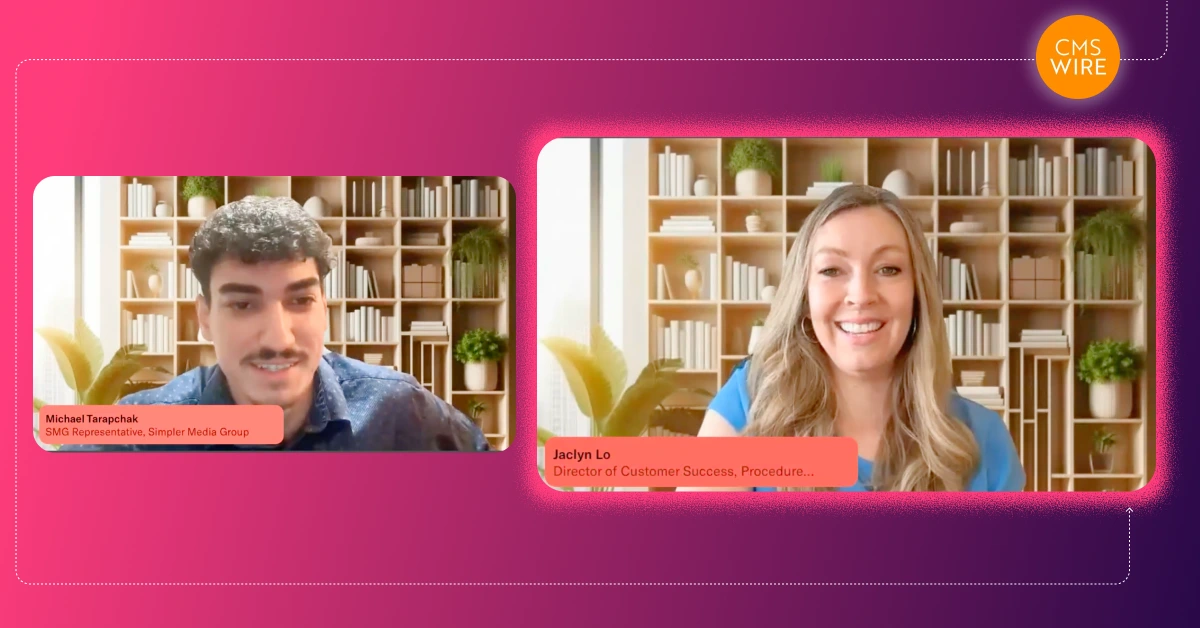
Procedureflow joined CMSWire for a live session on one of the most persistent frustrations in CX: the gap between what organizations know about their customers and what frontline teams can actually do with that knowledge in the moment.
We were joined by CX and operations leaders from across Financial Services, Insurance, IT Services, Computer Software, and Professional Services and the conversation struck a nerve from the first question.
Here's what we covered, what the audience told us, and what it means for how organizations need to think about insight execution.
The Problem: You Have the Data. Your Agents Don't Have the Answer.
Gartner research shows that while 80% of organizations plan to use customer data to improve service, only 14% are seeing significant impact from those efforts. Procedureflow's Director of Customer Success, Jaclyn Lo, named this the insight execution gap and it's not a data problem. It's a delivery problem.
Most customer signals are sitting in dashboards. They get reviewed in weekly meetings, which is valuable. But when an agent is on the phone with a frustrated customer right now, that insight isn't helping them at that moment. Knowledge exists. The systems exist. The gap is in what happens between insight and action, at the frontline, in real time.
What Our Audience Told Us
We ran four live polls throughout the session. Here's what the room said.
What area would benefit MOST from connecting signals to workflows?
First-contact resolution — 67%
Ensuring compliance and accuracy — 17%
High-emotion interactions — 8%
Scaling AI responsibly — 8%
FCR came far ahead. The moment of truth is still that first interaction and agents need real-time support to resolve it well.
What impact would operationalizing insights have on your CX?
All of the above — 75%
Faster resolution — 10%
More consistent service — 5%
Better agent confidence — 5%
Reduced escalations — 5%
Three-quarters of respondents selected "All of the above" meaning they see a broad, compounding return. Agents become more confident. Resolution speeds up. Escalations drop. Consistency improves. These outcomes are connected.
What's the biggest barrier to acting on insights in real time?
Siloed systems — 45%
Technology limitations — 18%
Agents don't have guidance within their workflows — 14%
No clear process for turning signals into action — 14%
Lack of ownership — 9%
Nearly half of attendees identified siloed systems as their primary barrier consistent with McKinsey's finding that 70% of organizations cite silos as limiting their effectiveness. The data exists; it just isn't flowing to where decisions happen.
Where is your organization with operationalizing customer insights?
We collect data but don't act on it in real time — 47%
We have some signals feeding into workflows — 26%
We have mature systems connecting insights to action — 11%
We're actively building real-time capabilities — 11%
We're not sure — 5%
Nearly half of the room is still in "collect but don't act" territory. Only 11% have mature systems in place. Most organizations are aware of the problem but not yet equipped to solve it at the point of interaction.
Three Reasons Insights Fail to Reach the Frontline
Jaclyn walked through the structural breakdowns that create the execution gap.
Insights are siloed
Sentiment data lives in one tool, transcripts in another, behavioral analytics in a third. When data can't flow into a unified execution layer, it can't inform real-time decisions.
There's no execution layer
An alert that says "customer sentiment dropped" tells an agent something is wrong. It doesn't tell them what to do. Without a guided next step embedded in the workflow, the insight has nowhere to go.
The timing is off
Traditional CX operates on hindsight. Salesforce research found that 83% of customers expect immediate engagement. By the time insights are summarized, reviewed, and passed to the frontline, the moment has already passed.
What "Operationalizing Insights" Actually Means
A phrase like "operationalizing insights" can mean a lot of things. Here's a practical definition:
Operationalizing insights means turning customer signals into structured, real-time guidance that changes what employees do in the moment. Not alerts or dashboards embedded workflows that adjust based on live context.
A concrete example: a sentiment analysis tool detects frustration mid-chat. An operationalized system responds immediately surfacing a guided workflow that tells the agent to acknowledge the emotion, presents three resolution paths, and clarifies when to escalate. The insight doesn't just inform. It directs.
The Cost of Not Acting
Organizations often weigh the cost of implementing new systems. Fewer consider the cost of staying still. There are four risks that come up consistently.
Consistency breaks down. Without structured guidance, every agent interprets signals differently. Service quality varies — and McKinsey research links inconsistency to roughly 70% of negative customer experiences.
AI investments underperform. Forrester found that AI paired with structured workflows drives 20–30% better first-contact resolution than AI alone. Without the execution layer, the AI ROI doesn't materialize.
Institutional knowledge walks out. By 2030, 61 million baby boomers will retire. If expertise isn't structured and embedded in workflows, it leaves with them.
Handle time and escalations climb. Organizations with structured knowledge see 25–35% fewer escalations and 15–20% reductions in handle time. Without it, those numbers move in the wrong direction.
Five Capabilities to Look For
When evaluating platforms to close the insight execution gap, these five capabilities separate effective solutions from basic workflow tools.
- Native integration with your signal ecosystem
Look for platforms that integrate with your existing CRM, contact center, and analytics tools pulling signals directly into agent workflows without creating new silos or forcing a rip-and-replace.
- Intelligent automation at the point of action
Effective platforms enable automated task execution, real-time calculation engines, and dynamic data synchronization all woven into the workflow itself, not bolted on as a separate step.
- Context-aware, adaptive guidance
Static scripts don't cut it. The platform needs to read the situation who's the customer, what's their history, what signal just triggered and present the exact steps for that specific scenario. Even better: workflows that adapt mid-interaction when sentiment shifts, or a compliance trigger appears.
- Embedded delivery within existing tools
Guidance should surface in Salesforce, Zendesk, ServiceNow, Oracle wherever agents already work. No tab-switching. No separate login. Seamless support within their natural workspace.
- AI-powered process design
How quickly can you build and update workflows as your business evolves? Look for AI-assisted process design that transforms text-based procedures into structured, visual workflows instantly so new knowledge gets deployed fast and stays current with reduced manual effort.
The organizations winning at insight operationalization aren't just connecting data they're creating closed-loop systems where insights trigger intelligent action, guided by context, delivered seamlessly, and continuously refined.
Real Results: What This Looks Like in Practice
Flexiti — Financial Services, Payment Processing
Flexiti's agents were spending significant time searching through hundreds of documents scattered across SharePoint during customer calls. After deploying embedded guided workflows with task automation, Flexiti achieved a 40-second reduction in average handle time — largely by eliminating hold time and reducing attrition.
Brooks Running — Athletic Footwear
Brooks Running needed to onboard seasonal staff faster and deliver consistent service across locations. By replacing static training materials with interactive, guided workflows, they achieved a 50% reduction in training time and improved speed-to-proficiency across their entire customer service team.
The Takeaway for CX Leaders
You can have the best analytics, dashboards, and AI models. But if your frontline teams are still guessing what to do next, you haven't operationalized anything.
The organizations that will differentiate on customer experience in the next few years aren't the ones with the most data. They're the ones that have built the execution layer connecting insight to action in real time, in context, in the tools agents already use.
The question for leaders isn't whether you have the insight. It's whether your team can act on it when it matters most.
Want to see how Procedureflow helps teams operationalize customer insights? Request a demo
Miss the live session? The recording is available on request.