88% of customers say good service makes them more likely to purchase again. But here's the problem: while your competition is still making agents hunt through SharePoint folders and scroll through PDF policies, elite service teams have fundamentally changed how knowledge flows.
They don't treat knowledge like a reference library. They treat it like real-time intelligence that powers every decision guiding agent through complexity instead of making them search during the most critical moments.
The result isn't just a faster service. It's a transformative customer experience: First-call resolution goes up. Escalations drop. And agents handle your most complex scenarios with the confidence usually reserved for your veteran performers.
This is where the gap between average and exceptional gets created.
The three capabilities that separate elite service teams from everyone else
1. They transform knowledge into guided action (not documents agents have to decode)
Picture this: A customer calls for a refund that falls outside standard policy. Your agent needs to verify the account, check out purchase history, determine eligibility for an exception, and understand the approval threshold; all while the customer waits.
Most teams: The agent opens three browser tabs, scans a 12-page PDF, pings their supervisor on Slack, and hopes they haven't missed a critical step.
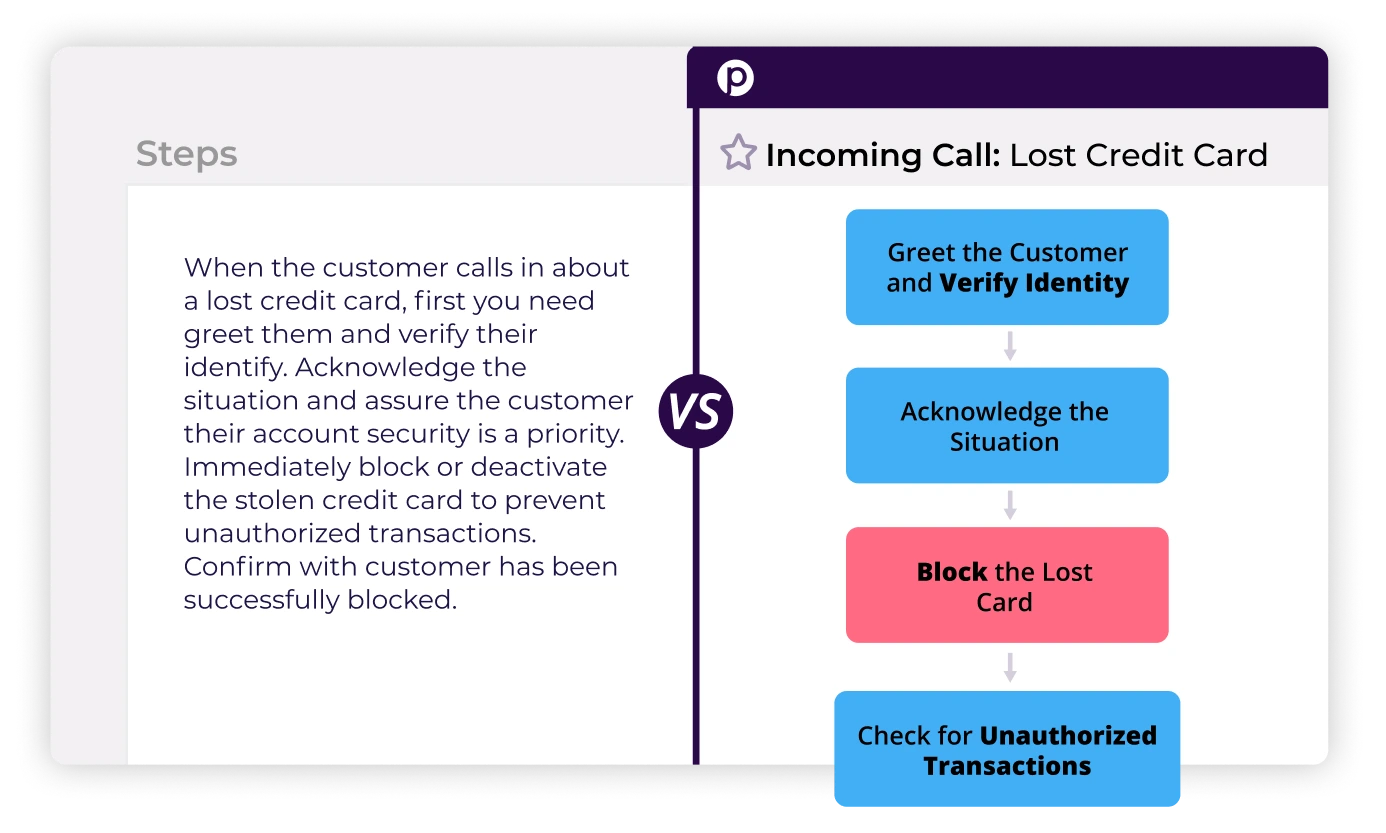
Elite teams: The agent follows a visual pathway that asks the right questions in sequence, surfaces the relevant policy at each decision point, and guides them to the correct resolution; consistently, every time.
That's not just efficiency. That's the difference between a customer saying, "they had no idea" versus "they knew exactly what to do."
Procedureflow is built precisely for this: converting your complex policies and procedures into interactive, step-by-step flows that guide agents through "what happens next" with absolute clarity. No hunting. No guessing. Just follow the path to the right outcome.
2. They standardize outcomes without robotic scripts (because consistency is what customers actually care about)
Here's what customers don't notice: whether your agent used a script.
Here's what they do notice: whether the answer they got is the same one their colleague got yesterday, or the one they'll get if they call back tomorrow.
The best service teams don't script conversations. They embed decision logic:
-
When to verify identity versus when the system already did it
-
When exceptions apply and who can approve them
-
How to proceed confidently when two policies seem to conflict
-
What to say when you need to escalate versus when you can resolve immediately
With Procedureflow, teams capture how their top 10% of performers think the judgment calls, the nuanced decisions, the "I've seen this before" wisdom and make it instantly accessible to everyone.
The outcome? Your newest agent delivers the same quality experience as your most seasoned one. Not because they memorized more, but because the knowledge system guides them through complexity with the same intelligence.
3. They keep knowledge alive, governed, and actually trusted (because outdated information destroys confidence)
Here's the silent killer of customer experience: knowledge decay.
Processes change. Policies evolve. Your product team launches updates. But documentation? It stays frozen in time until agents stop trusting it entirely.
According to Salesforce research, 86% of service professionals say customer expectations are higher than ever before. You can't meet rising expectations with information your agents don't believe.
Elite teams treat knowledge as a living operational system:
-
Centralized ownership ensures one source of truth
-
Review cycles keep content current as business changes
-
Version control tracks what changed and when
-
Governance workflows make updates fast without breaking accuracy
Procedureflow supports this with workflows that are genuinely easy to maintain so when your returns policy changes or your new product launches, agents get updated guidance immediately. Not weeks later. Not through a Slack announcement they might miss. Immediately.
Real transformation: How Flexiti turned knowledge chaos into customer experience excellence
The situation: Flexiti, a leading consumer financing provider, had a problem every contact center knows knowledge scattered across SharePoint, inconsistent handling of exceptions, and agents who spent more time searching than serving.
Customer conversations stalled. Agent confidence eroded. Experience suffered.
The transformation: Flexiti moved to Procedureflow to create a single source of truth that delivered answers exactly when agents needed them embedded in the flow of work, not buried in documentation.
The impact: This wasn't just an efficiency play. It fundamentally transformed the agent and customer experience:
“Implementing Procedureflow has made our agents' lives easier by creating consistency and removing the intimidation and guesswork around our processes. Agent satisfaction is the highest it's ever been in our contact center, and customers benefit from a better, more consistent customer experience.”
Ryan Janicki, VP of Operations, Flexiti
The numbers tell the story too: Flexiti decreased average handle time by 40 seconds per call. When you're handling thousands of interactions daily, that's not an incremental improvement; it's a complete transformation of customer experience capacity.
The real cost of the status quo
Every minute your agents spend searching is a minute your customers spend waiting.
Every inconsistent answer is a customer who wonders if they got the "right" person.
Every time an agent escalates because they're not sure is a customer who questions your team's competence.
Knowledge isn't valuable when sitting in a database. It's valuable when it shows up at the exact moment an agent needs to make a decision formatted not as "information to read" but as "actions to take."
Research from Salesforce confirms what elite teams already know: good customer service must be fast, seamless, and consistent. But you can't deliver that experience if your knowledge system makes agents hunt instead of guiding them to act.
What is the gap between your service today and an exceptional customer experience? It's not training. It's not hiring. It's how your knowledge shows up in the moment of truth.
Transform how knowledge powers your customer experience
Your agents shouldn't hunt for answers. They should be guided to the right decision, every time.
The difference between searching and being guided is the difference between acceptable service and exceptional customer experience.