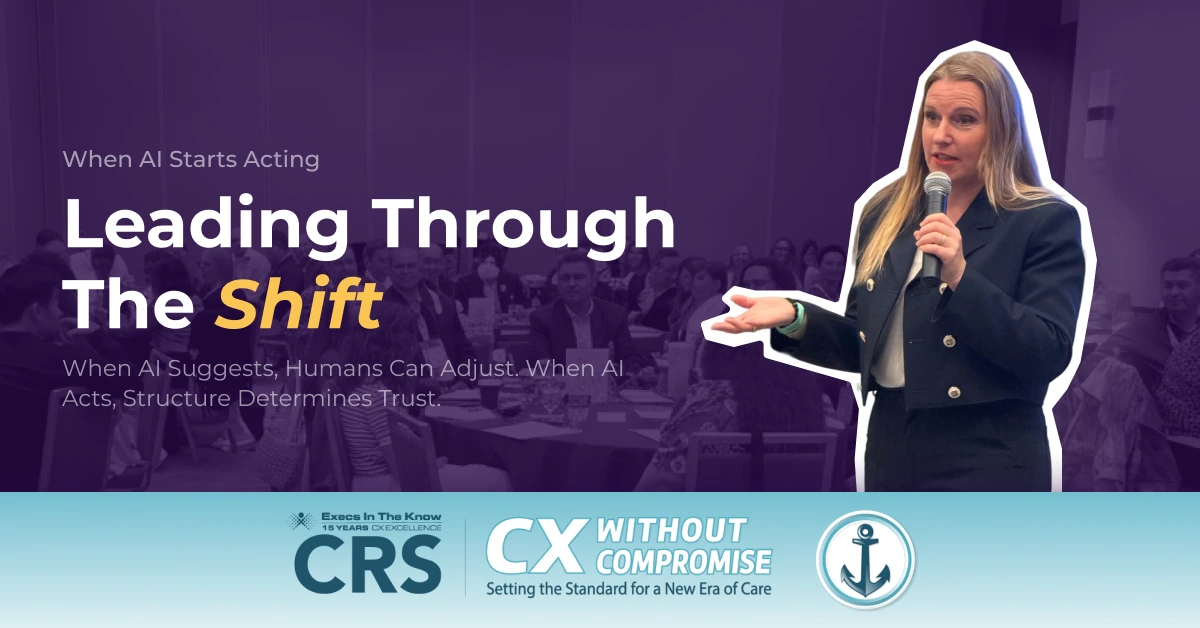
When AI Starts Acting: Key Takeaways from Sarah Jeanneault's Session at CRS 2026
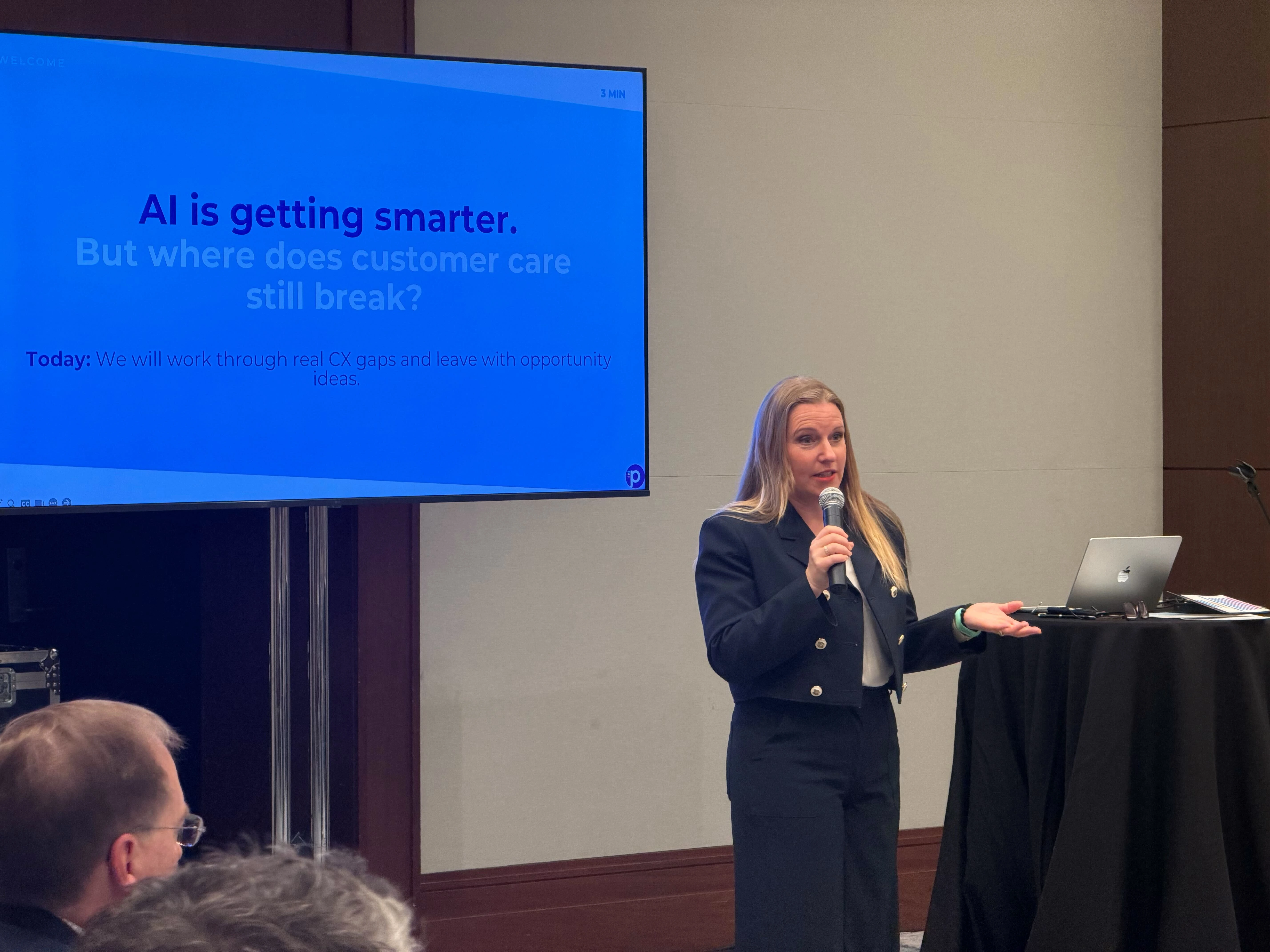
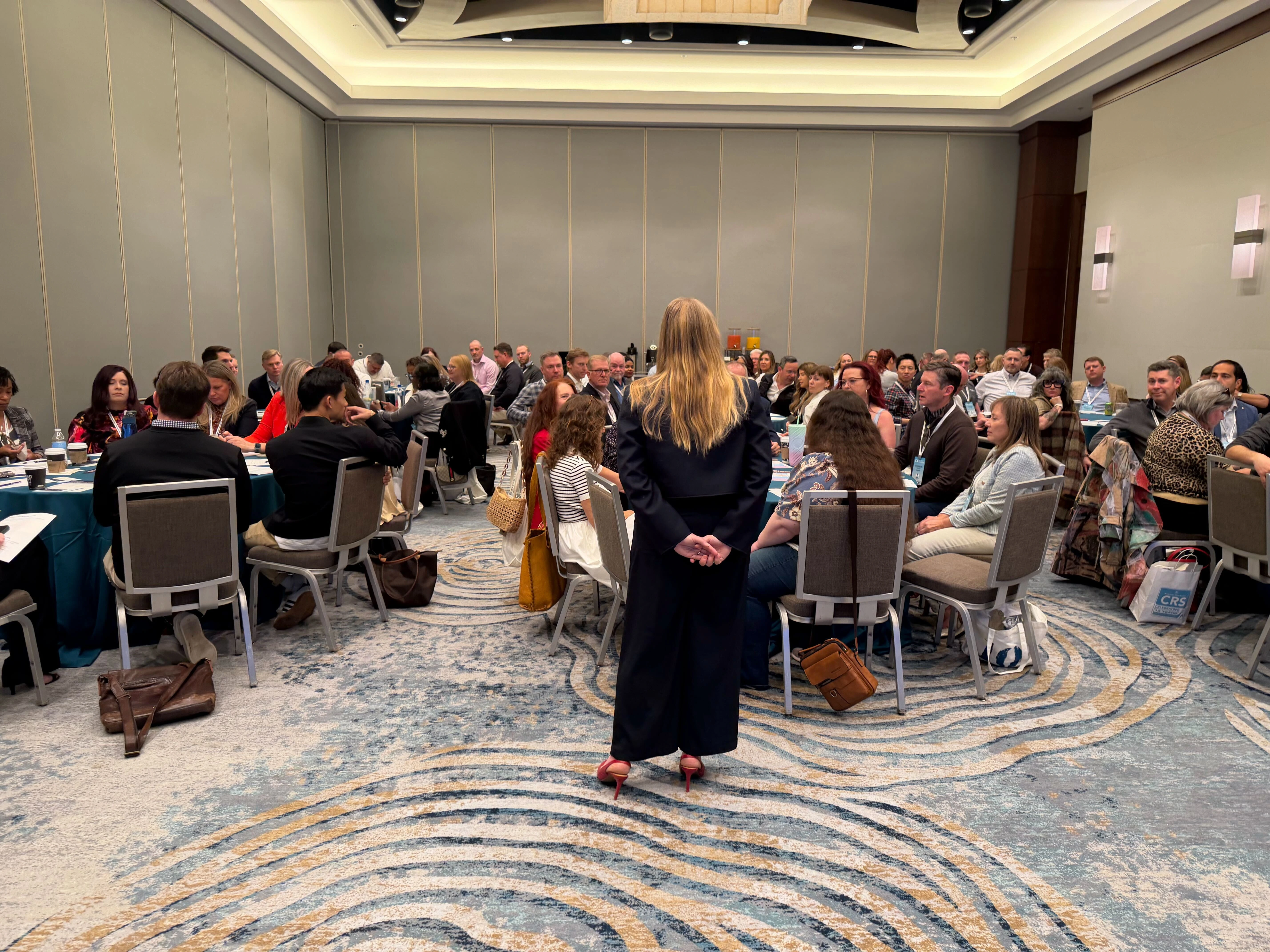
Last week, Procedureflow's VP of Marketing, Sarah Jeanneault, took the stage at the Customer Response Summit (CRS) 2026 in Amelia Island, Florida. The conversation in the room shifted quickly from "what AI can do" to "what your organization needs to be ready for it".
Her session, "When AI Acts: Leading Through the Shift from Copilot to Agent," was one of the most talked-about of the event. Here is what she covered, and why it matters for every customer experience and contact center leader navigating agentic AI right now.
What Does It Mean When AI Starts Acting in Customer Care?
Agentic AI in customer care means AI that executes independently. It resolves transactions, routes inquiries, applies policy logic, and moves work across systems without pausing for human approval at each step.
That is meaningfully different from a copilot, which recommends actions and leaves the decision to the agent. And it is a world away from a chatbot, which handles simple, scripted interactions.
Sarah opened her session with a question that stopped the room:
“When AI starts acting on behalf of your team, who is accountable?"
As long as AI plays a supporting role, humans stay in control. The moment AI begins executing independently, the accountability equation shifts entirely.
“By 2028, agentic AI is expected to handle 68% of customer experience interactions with technology partners."
Cisco Global Research, 2025 (7,950 decision-makers across 30 countries)
Source: Cisco Newsroom, May 2025
From Chatbot to Copilot to Agentic AI: Understanding the Progression
Sarah walked the audience through the three stages most contact center organizations are navigating right now:
Stage 1 - AI as Responder: Chatbots that react to prompts, deflect tickets, answer straightforward questions. Reactive. Limited.
Stage 2 - AI as Assistant: Copilots that sit alongside your agents, surfacing information and suggesting next steps. Humans still make the call.
Stage 3 - AI as Actor: Agentic systems that execute. They process requests, make decisions within defined parameters, and move work across systems independently.
Most organizations are managing all three simultaneously. And that third stage is not just a technical upgrade. It is a change in risk, accountability, and operational design.
“93% of IT leaders report intentions to deploy autonomous AI agents within two years, and nearly half have already started.”
MuleSoft 2025 Connectivity Benchmark Report (1,050 IT leaders surveyed)
Source: MuleSoft / Salesforce Connectivity Benchmark Report, 2025
Why Most Contact Centers Are Not Ready for Agentic AI
The biggest barrier to agentic AI readiness is not the technology. It is the knowledge infrastructure beneath it.
Most contact centers still rely on document-based knowledge: policies in long PDFs, procedures scattered across shared drives, decision logic embedded in workflows that were never designed to be machine-readable.
That approach works when human agents are doing the interpreting. Experienced team members know which policy applies to which situation. They fill in the gaps, ask clarifying questions, escalate when they are not sure. They compensate for ambiguity constantly, invisibly, at scale.
Agentic AI does not compensate. It executes on the structure it is given.
If that structure is fragmented, outdated, or unclear, those weaknesses do not disappear when AI touches them. They get amplified.
“The challenge is not capability. It is clarity. When decision paths are not explicitly mapped and ownership of knowledge updates is informal rather than governed, AI simply amplifies those inconsistencies.”
Sarah Jeanneault, CRS 2026
“23% of organizations are already scaling AI agents yet operational governance remains the primary barrier to broader deployment.”
McKinsey State of AI, 2025 (1,993 respondents across 105 countries)
Source: McKinsey State of AI Report, November 2025
What Are the Most Common Knowledge Infrastructure Gaps in Contact Centers?
In a live workshop exercise at CRS 2026, attendees broke into small groups and worked through three questions:
Where does customer care break in your organization?
What is the measurable business impact?
Why does that gap exist structurally?
Each group distilled their answers into a single Care Gap Statement: symptom, impact, root cause.
What struck Sarah was how fast people could do it. They did not have to think hard about where things break. The breakdowns were consistent across organizations of every size:
-
Inconsistent responses across agents handling identical inquiries, driving repeat contacts and eroded trust
-
High escalation rates triggered by unclear decision thresholds, where agents cannot determine the right path without human review
-
Low copilot adoption, because agents do not trust the logic underneath the suggestions
-
Extended handle times caused by knowledge living in four different places, none of them fast enough to find under pressure
-
Slow policy updates that take weeks to propagate because there is no centralized ownership or version control
These are not new problems. What changed in the room was the framing. Attendees stopped calling them performance issues and started calling them what they actually are: structural gaps.
“Service reps spend 66% of their time on non-customer-facing tasks. AI implementation is directly tied to reducing that friction but only when the underlying knowledge is structured.”
Salesforce AI Agent Research, 2024
Source: Salesforce AI Agents Statistics, 2024
How One Health Insurance Contact Center Fixed Its Escalation Problem
To ground the session in a real-world example, Sarah shared a case study from a large health insurance contact center handling complex benefit and claims inquiries. Escalation rates were high and leadership assumed it was a training problem.
It was not. The knowledge existed. It was just structured in a way that nobody could use confidently under pressure. Policies lived across documents. Decision paths were not mapped. Agents defaulted to escalation not because they did not know the answer, but because they could not find it fast enough to trust it.
The organization rebuilt its processes into clear, visual workflows with defined decision logic and governance controls. The policies did not change. The structure did.
Escalations dropped significantly. First-call resolution improved. The transformation was not technological. It was architectural.
What Are the 5 Stages of AI Maturity for Contact Centers?
Sarah closed with a maturity framework that resonated strongly with the room. Organizations move through five stages on the path to confident agentic AI deployment:
Procedureflow's Intelligent Knowledge Foundation framework, as presented at CRS 2026, showing the five-stage path from document-based knowledge to agentic AI
Stage 1: Documented
Information exists but is static, scattered, and interpretive. You are dependent on SMEs to fill the gaps.
Stage 2: Guided
Processes are structured step by step. People can follow them without needing context or experience to interpret.
Stage 3: Collaborative
Governance and version control are formalized. Knowledge is owned, not assumed.
Stage 4: Strategic
Knowledge is connected to analytics and continuous improvement. Teams can identify where breakdowns occur and act on them systematically.
Stage 5: Innovative
AI acts autonomously within defined guardrails. This is where the magic happens but only if the earlier stages are solid.
The sequence matters. Organizations that try to leap directly to Stage 5, driven by competitive pressure or boardroom enthusiasm, are making a costly mistake. Automating ambiguity does not eliminate it. It multiplies it. Scaling inconsistency does not fix it. It accelerates it.
“The differentiator will not be who adopts AI first. It will be who builds the strongest operational clarity beneath it.”
Sarah Jeanneault, CRS 2026
“Gartner predicts agentic AI will autonomously resolve 80% of common customer service issues without human intervention by 2029; 30% reduction in operational costs.”
Gartner, March 2025
Source: Gartner Press Release, March 5, 2025
How Do You Know If Your Organization Is Ready for Agentic AI?
As the session wrapped up, conversations kept going at the tables. Leaders were asking each other the same questions Sarah left them with:
Who currently owns knowledge updates in your organization?
Is your decision logic formally documented, or just assumed?
If AI executed tomorrow based entirely on how your systems are structured today, would you feel confident?
That last question is the one worth sitting with. Not because the answer is supposed to be yes right now. But because asking it is the leadership shift this moment demands.
The Real Takeaway
AI will keep advancing. Its role in customer experience will keep expanding. The differentiator will not be who adopts it first.
It will be who builds the strongest operational clarity beneath it.
When AI suggests, humans can adjust. When AI acts, structure determines trust.
That is the shift. And it extends far beyond technology.