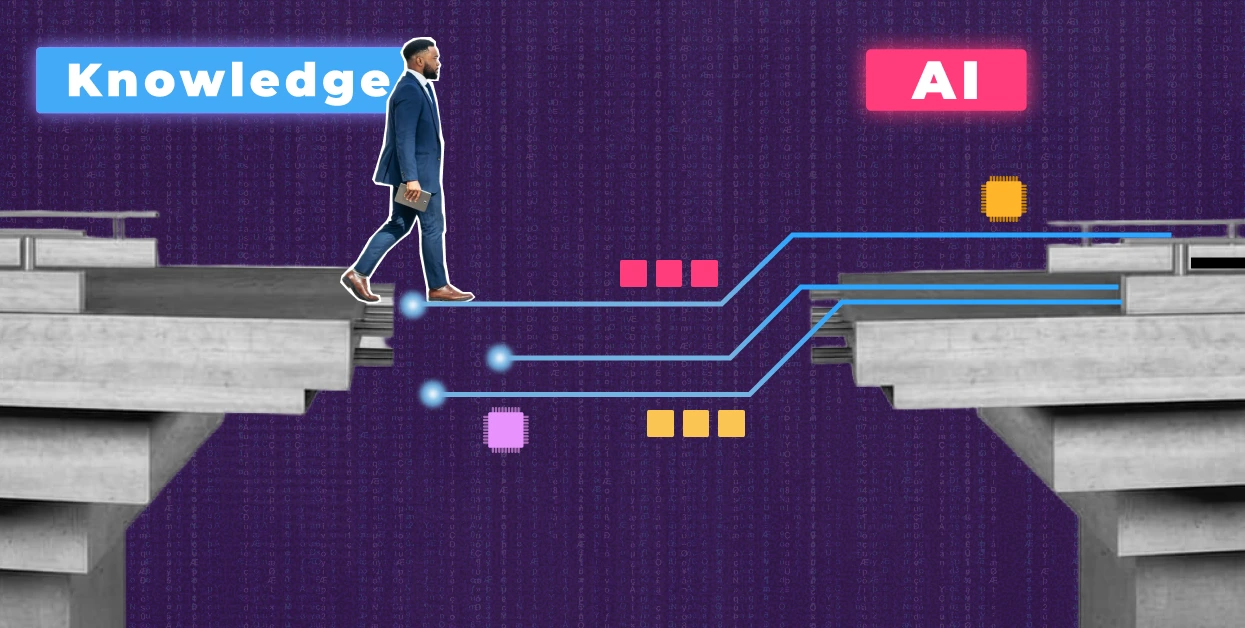
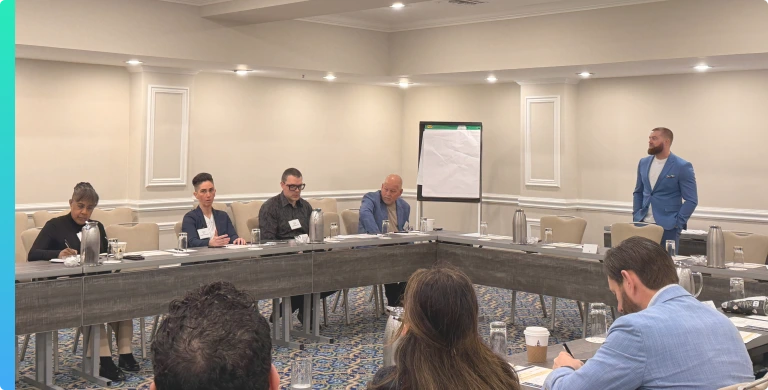
The knowledge gap in AI contact centers is one of the most underexamined risks in modern customer experience operations. On March 10th, Aaron Craig, VP of Sales at Procedureflow, led a 50-minute breakout session at The Biltmore Miami during Consero CX, a gathering of contact center leaders navigating the intersection of AI, agent performance, and operational scale.
The session, KnowledgeBridge: The Hidden Knowledge Gap, was not a product pitch. It was a structured working session built around one question that every leader in the room already felt but had not yet named: if AI is acting in your brand's name, orchestrating processes and resolving issues without a human in the loop, what exactly is it running on?
What Is a Knowledge Gap in a Contact Center?
A knowledge gap in a contact center is the distance between the information that exists inside an organization and the information that is structured, accessible, and usable in real time. It is not a shortage of content. It is a failure of infrastructure. And in an agentic AI environment where automated workflows and process orchestration are executing on that knowledge, the failure does not stay contained.
Why Are Most AI Foundations Not Keeping Up?
AI contact center deployments are accelerating faster than the knowledge foundations supporting them. The numbers confirm it: 88% of organizations are now using AI in at least one business function, up from 72% just twelve months ago. When AI is deployed on a strong foundation, the results are measurable: a 14% increase in issues resolved per hour and a 9% reduction in handle time.
But those gains are not guaranteed. They depend on something that rarely makes the headline:
The quality of the knowledge the AI is running on.
Contact centers have moved through three distinct AI eras: rules-based chatbots, copilots that assist agents in real time, and now agentic AI that does not just suggest. It acts. It orchestrates. It resolves. It executes multi-step processes and makes decisions in your brand's name, without a human in the loop.
Every step up that ladder raises the stakes of getting knowledge wrong.
62% of organizations say poor data and knowledge quality is a top barrier to AI effectiveness, and knowledge gaps are cited as the leading structural reason AI deployments underperform.
Precisely/livepro, 2024
Is the Problem a Lack of Knowledge or a Lack of Usability?
Short answer: it is a usability problem, not a volume problem.
Knowledge is not missing in most organizations. It exists in PDFs, shared drives, tribal memory, and the institutional expertise of a team lead who has been there eleven years and whose departure quietly keeps leadership up at night. The problem is usability in real time: getting the right answer to the right person at the right moment, structured well enough for both a human and an AI to execute from it.
When participants at the session were asked to name the last interaction that went wrong because of a knowledge problem in their AI contact center, the answers were immediate:
-
Agents onboarded without the context they needed
-
The same customer question answered differently by two agents on the same shift
-
Compliance calls that depended on memory, not a documented decision path
-
AI copilots surfacing answers agents could not verify or trust
-
Knowledge scattered across too many tools, with no single reliable source
What Does a Knowledge Gap Actually Cost an Organization?
The session moved from diagnosis to financial and operational consequence. Leaders worked through a Knowledge Risk Card, naming the gap most likely to cause their first AI failure, and what customer or compliance exposure that gap creates.
The patterns fell into three categories:
Customer Risk
Inconsistent or wrong answers erode trust faster than rudeness does. Customers do not always name the knowledge failure, but the outcome is the same: they do not call back, or they do not stay.
53% of bad customer experiences lead to customers reducing spend with that brand.
Qualtrics, 2024
Compliance Risk
Judgment calls that should be process-driven decisions, made under pressure by agents working from memory rather than a structured decision path. Compliance gaps that a regulator has not found yet.
Operational Risk
Inconsistency that compounds. One agent's workaround becomes the floor's standard. AI does not slow that down. It speeds it up.
The key line from the session:
AI does not fix knowledge gaps. It exposes them. At scale.
A chatbot with bad knowledge gives one wrong answer at a time. A copilot with bad knowledge misleads agents across every shift. Agentic AI with bad knowledge acts autonomously before anyone catches it.
What Does a Knowledge-Ready Foundation Look Like?
A knowledge-ready foundation for agentic AI and process orchestration in contact center operations has six elements. The second half of the session had participants map their current state against each one:
-
Clear processes: structured decision paths, not paragraph descriptions
-
Structured knowledge: organized so both humans and AI can execute from it, not just read it
-
Governance: defined ownership, update accountability, and a clear process when AI acts on outdated content
-
Decision guidance: agents know exactly what to do in unclear situations
-
Accessibility: knowledge surfaces in the flow of work, not a separate tab
-
Human oversight: someone accountable for what AI does in your organization's name
The accountability question was direct: Who actually owns this right now, not who should own it? If a name could not be supplied, that absence was named as the gap itself.
To understand how Procedureflow helps organizations build this foundation, visit the features page
How Do You Close a Knowledge Gap Before Scaling AI?
The session closed with a three-layer framework for closing the knowledge gap in a sequence that actually holds. Most organizations skip steps, which is why deployments underperform.
Layer 1: Capture
Knowledge capture is the process of getting information out of people's heads and into structured form. Decision trees, step-by-step processes, verified answers, not policy paragraphs. Start by identifying your top 20 most-asked agent questions and documenting the correct answer for each one.
Layer 2: Structure
Knowledge structure means organizing knowledge, so it is executable, not just readable. AI and agents should be able to follow it, not just refer to it. Every knowledge area needs an assigned owner. If no one owns it, no one will update it.
Layer 3: Govern
Knowledge governance is the system that keeps knowledge current as the business changes. Regular review cycles, a process for flagging outdated content, and clear accountability when AI acts on it. A 30-minute monthly knowledge review with one person and one agenda item, what broke last month and why, is a practical starting point.
The teams that win with AI are not the ones who spent the most on the technology. They are the ones who did the unglamorous work first.
The Bottom Line: AI Will Scale Whatever Knowledge You Have
By 2025, 80% of customer service and support organizations will be applying generative AI in some form. The differentiator will not be who adopted it or who deployed the most sophisticated agentic AI or process orchestration tools. It will be whose knowledge foundation was strong enough for AI to execute correctly. Gartner via Plivo, 2024
The readiness gap is not a technology gap. It is a knowledge infrastructure gap. The organizations that win with AI will not be the ones who moved fastest. They will be the ones who paused long enough to ask what their AI was actually running on, and then fixed it. The ones closing that gap now are the ones who will see those 14% efficiency gains instead of scaling the problems they already have.
AI will scale whatever knowledge you have. Make sure it is worth scaling.
Interested in how Procedureflow helps contact centers structure and govern their knowledge foundation for AI-ready operations? Visit our features page to learn more.