Why 2026 Is the Year AI Stopped Waiting to Be Asked
For most of the last three years, enterprise AI has meant a chat window. You typed a question, a model answered, and a person decided what to do next. That era is ending. Gartner now forecasts that 40% of enterprise applications will embed task-specific AI agents by the end of 2026, up from under 5% just a year earlier, one of the fastest technology adoption curves on record, comparable in speed to the early cloud migration wave. Enterprise-wide, 88% of organizations report regular AI use in at least one business function, and 79% say they've implemented AI agents at some level.
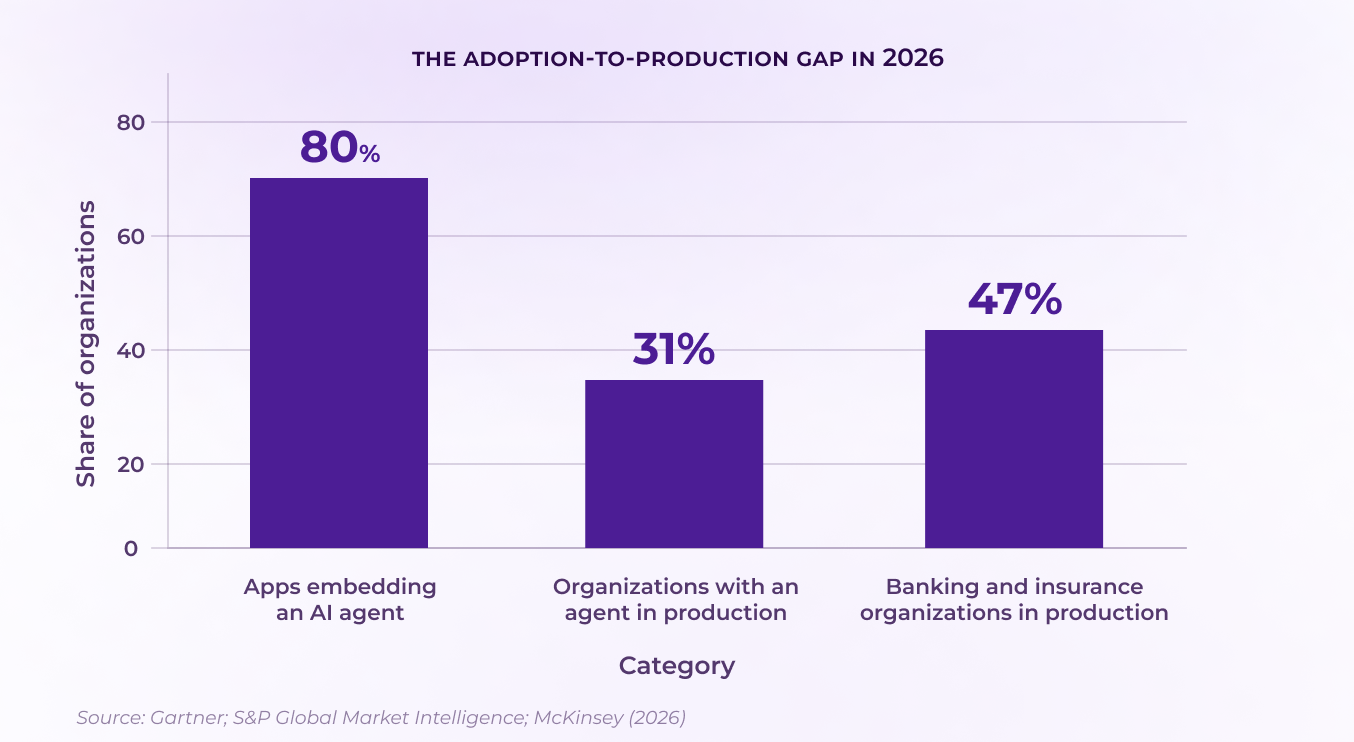
That's the headline. The harder truth sits just beneath it: adoption and production are two very different numbers. Only about 23 to 31% of organizations have actually scaled an agent into production, and Gartner expects more than 40% of agentic AI projects to be cancelled by the end of 2027 due to unclear ROI, weak governance, or brittle integration. The gap between "we're using AI agents" and "we're running AI agents reliably, at scale, with an audit trail" is where 2026 is being won and lost.
This is the shift agentic AI represents: not a smarter chatbot, but a system that can plan a sequence of steps, pull live data from the tools a business already runs on, take action, and know when to hand off to a human. Understanding that shift, and what separates the organizations closing the production gap from the ones stuck in pilot purgatory, is now a board-level question across financial services, healthcare, utilities, software, and customer service.
What Is Agentic AI?
Agentic AI is artificial intelligence that can pursue a goal across multiple steps with limited human supervision, reasoning through a task, deciding what to do next, calling on tools or systems to do it, and adapting when conditions change. It differs from a standard chatbot or generative AI assistant in one keyway: a chatbot responds to a single prompt, while an agent owns an outcome. Ask a generative AI tool to summarize a policy, and it summarizes the policy. Give an agent the goal of resolving a billing dispute, and it retrieves the account, checks the applicable policy, applies the correct workflow, executes the refund, and only escalates if it hits a case the rules don't cover.
The practical difference shows up in numbers. Analysts at UJET put it simply: traditional AI deflects, agentic AI resolves.
The Data: How Fast Is Agentic AI Actually Moving?
A few figures anchor where the enterprise market stands in mid-2026:
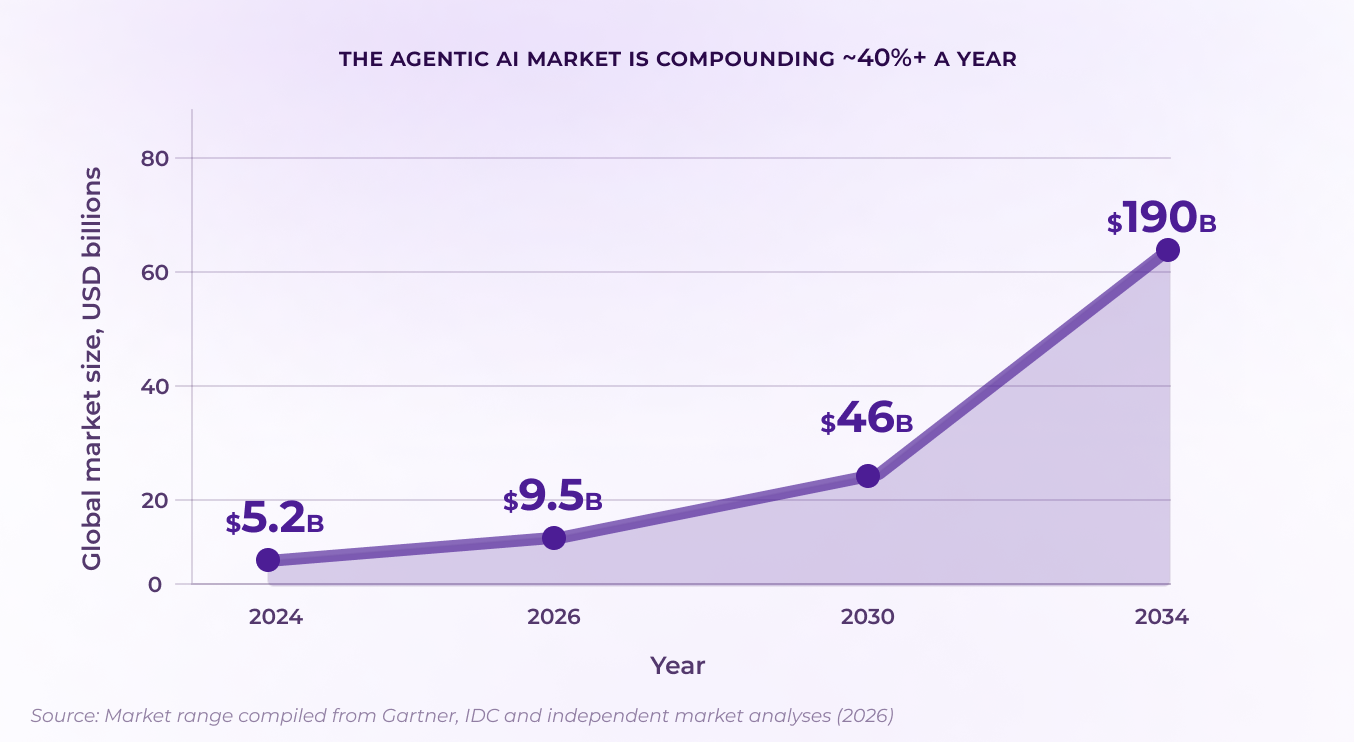
Market size: The global agentic AI market is estimated between $9 to 10 billion in 2026, on track to grow at a 40%+ compound annual rate toward the $140 to 200 billion range by the early 2030s, according to multiple market analyses.
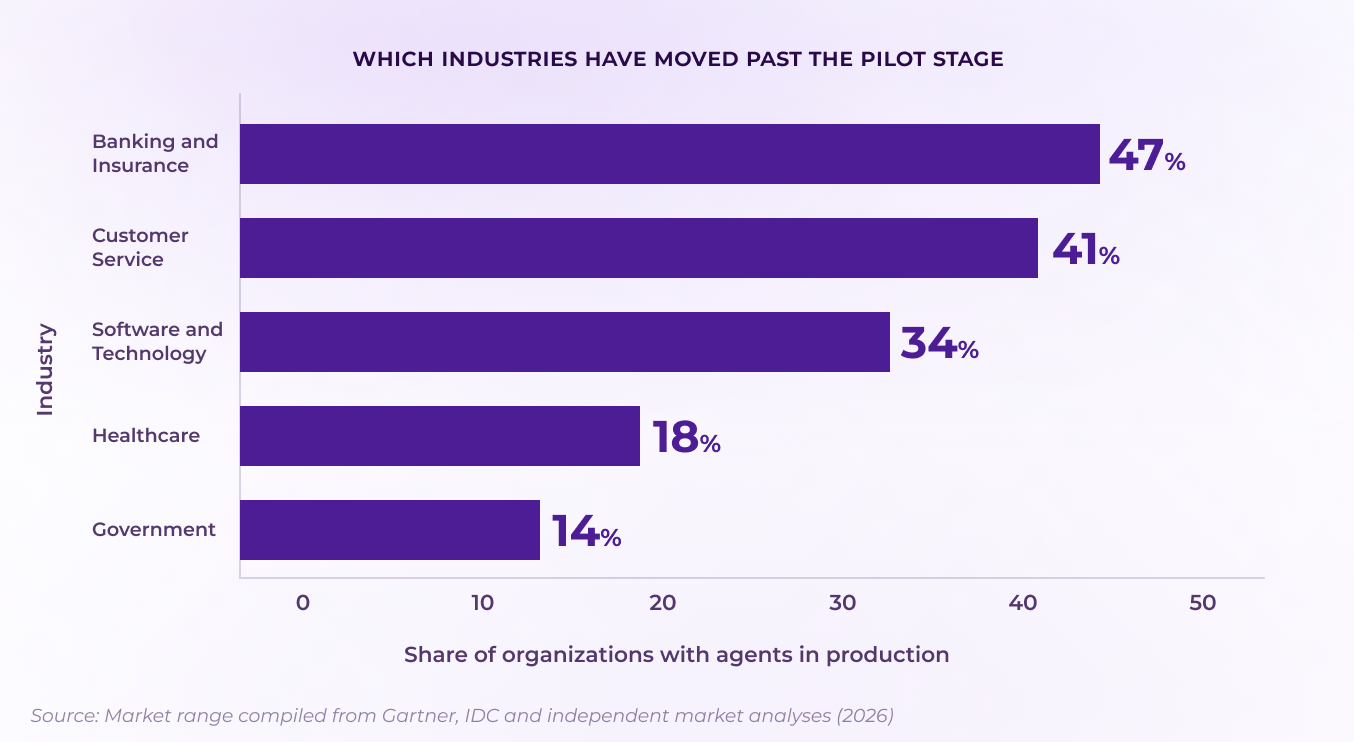
Adoption vs. production: Roughly 80% of newly shipped or updated enterprise applications now embed at least one AI agent, but only about 31% of enterprises have an agent running in production at scale, and banking and insurance lead that production number at roughly 47%, while healthcare and government trail.
Time to value: Median time-to-value on agent deployments is about 5.1 months, with sales-development agents paying back in as little as 3.4 months and finance and operations agents closer to 8.9 months, per BCG and Forrester research.
Return on investment: Deloitte's 2026 State of AI in the Enterprise report finds enterprise agentic AI deployments returning an average of 171% ROI, with U.S. enterprises reporting even higher returns, roughly three times the ROI of traditional automation.
Readiness matters more than model choice: IBM's research found organizations with strong foundations (change management readiness, AI governance, data governance, real-time data integration, system interoperability, and financial integration) are 5.4 times more likely to succeed with autonomous workflow adoption than those without.
That last point is the thread running through every industry example below: the constraint on agentic AI isn't model of intelligence anymore. It's whether the organization has structured, governed, and connected knowledge for the agent to act on.
How Industries Are Actually Adopting Agentic AI
Financial Services
Financial services are the most agent-mature vertical, with roughly 92% of banking and finance contact centers reporting some form of AI use and production-agent adoption around 47%, the highest of any sector. Banks are deploying agents for credit underwriting, fraud detection, portfolio risk analysis, and customer advisory work, largely because the processes are well-documented, high-volume, and rules-governed, exactly the conditions agentic AI performs best under. Regulatory scrutiny remains the biggest brake: 60% of finance leaders cite data governance and security as their primary barrier to scaling.
Healthcare
Healthcare adoption is accelerating but starting from further back. More than 80% of health systems now prioritize agentic AI for clinical operations, care delivery, and revenue cycle management, and 85% of U.S. healthcare leaders plan to increase agentic AI investment over the next two to three years, with 98% expecting at least a 10% cost reduction. Early wins cluster around administrative burden (ambient clinical documentation, prior authorization, claims adjudication) rather than diagnosis or treatment decisions, reflecting the higher cost of error and the regulatory weight of HIPAA and equivalent frameworks in patient-facing use cases. Mount Sinai Health System and Mayo Clinic are among the systems publicly piloting agentic workflows in 2026, alongside the UK's NHS.
Utilities
Utilities sit lower on the adoption curve than banking, but the use case fit is strong: field service dispatch, outage response, and compliance-heavy maintenance procedures are exactly the kind of structured, repeatable processes agentic AI handles well. Utilities have historically been constrained by legacy systems and thinner AI budgets rather than an absence of use cases, which is why the sector is increasingly buying agent-ready workflow infrastructure rather than building it internally.
Software and Technology
Software companies are both the biggest builders and the fastest adopters of agentic AI. Coding and technical work remains the single largest real-world agent use case; about a third of all Claude.ai activity relates to computer and technical tasks, per Anthropic's Economic Index, and engineering organizations are increasingly using agents for code review, testing, and autonomous pull requests.
Customer Service and Contact Centers
Customer service is the proving ground where "does the agent actually resolve the issue, or just deflect it" gets tested at volume every day. In 2026:
Median tier-1 deflection across enterprise CX programs sits around 41%, with top-quartile programs closer to 59%.
AI-handled resolutions cost roughly $0.62 on average versus $7.40 for a human-handled resolution, per McKinsey.
88% of contact centers report using some form of AI, but only about 25% have fully integrated it into daily operations, the same adoption-versus-production gap seen enterprise-wide.
Voice AI now handles about 19% of inbound contact-center volume, up from 6% in 2024, with banking and telecom leading the shift.
Deloitte projects that within two years, nearly three in four companies will be using agentic AI at least moderately across their operations.
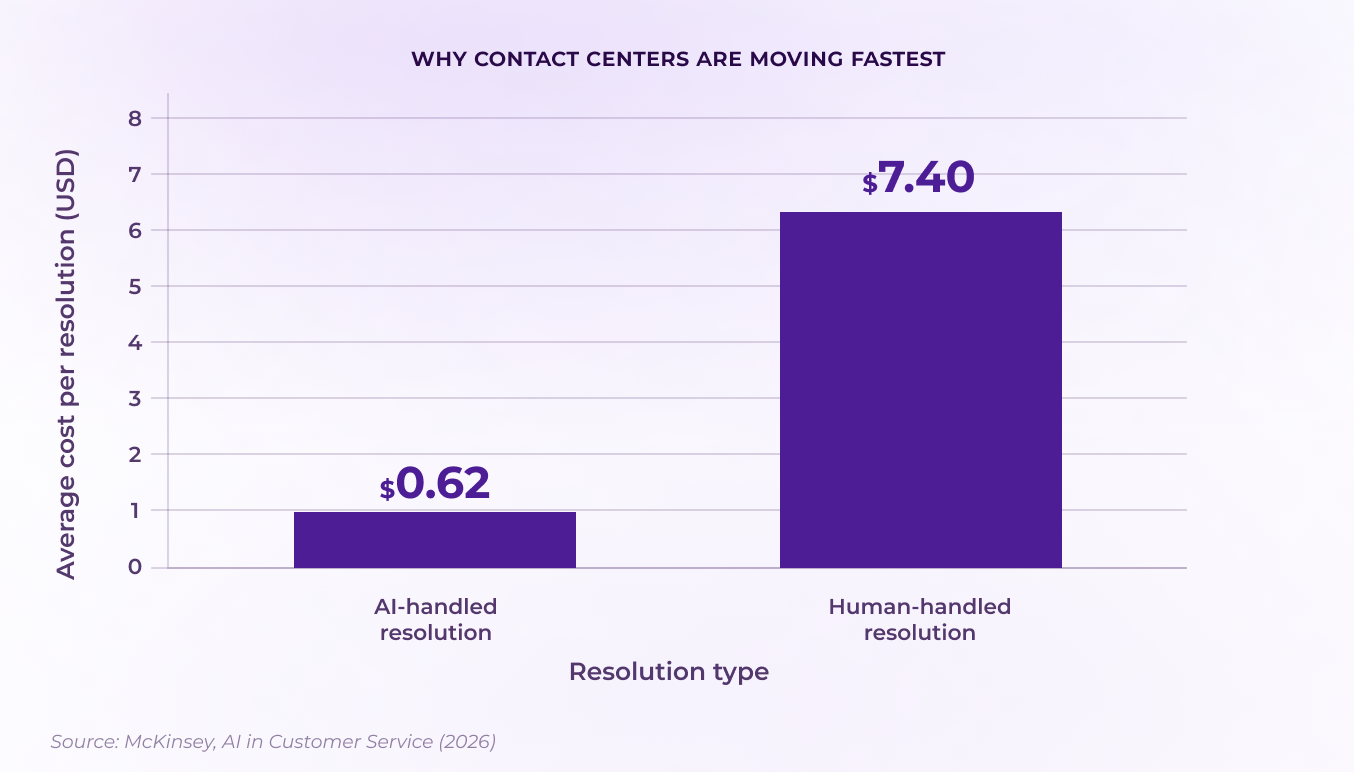
The consistent finding across every CX research firm: deflection alone is a vanity metric. The organizations getting real ROI are the ones measuring resolution: did the agent solve the problem, following the correct, current, compliant process, not just whether the customer avoided a human.
Canada Spotlight: What's Happening at the Big Six Banks
Canada's financial institutions are not just participating in the agentic AI shift; they're some of the most AI-mature banks in the world. Three of Canada's Big Six rank in the global top ten for number of AI researchers hired, and Canada accounts for roughly 14% of global AI research output and 9% of AI patents among the world's 50 largest banks, according to Evident's State of AI Research in Banking report.
A few concrete data points from 2026:
RBC spends more than CAD $5 billion a year on technologywith AI investment embedded in that figure, targets CAD $700 million to 1 billion in enterprise value from AI by 2027. Roughly 27,000 employees use its internal assistant, RBC Assist, daily, and another 8,000 Capital Markets employees use Aiden, the bank’s AI-powered trading platform.
TD publicly detailed its first agentic AI application in May 2026: an agent running inside its Layer 6 research lab that handles document scanning, income verification, policy validation, and underwriter-memo generation for mortgage and home equity applications. The result, independently measured by PYMNTS, was a pre-adjudication queue that used to average 15 hours now averaging under three minutes, with a human underwriter still making the final call. TD is targeting $1 billion in annual AI value by 2028.
CIBC's enterprise AI platform saved an estimated 600,000 hours of employee time within months of its 2025 firmwide launch, and its client-facing AI platform has helped generate more than $1 billion in new deposits.
BMO targets more than $1 billion in pre-tax profit from AI by 2030 and has opened a dedicated Institute for Applied AI & Quantum.
Scotiabank is rolling out assistive AI tools enterprise-wide as part of a broader modernization push.
National Bank of Canada, the smallest of the Big Six, has built what it calls an AI Factory to move projects from research into production, and its generative AI-powered complaint-summarization tool has delivered five to ten times productivity gains while improving regulatory compliance. The bank has also deployed multi-model machine learning for cheque fraud detection and a generative AI chatbot that gives branch advisors real-time, validated guidance.
Industry-wide, though, agentic AI in banking is still early relative to the hype: only about 16% of banks globally had deployed an agentic AI use case as of mid-2025, concentrated mostly in fraud detection and risk and compliance, per MIT Technology Review Insights. Regulatory hurdles, cost, and the complexity of legacy core systems remain the primary brakes, which is exactly why Canada's banking and telecom incumbents recently formed a joint AI consortium to build shared standards for agent governance and control, echoing the cheque-processing consortium the same banks formed in the 1990s.
The pattern holding across every one of these programs is the same one IBM's research surfaces globally: the banks pulling ahead aren't necessarily spending the most on models. They're the ones that treated structured, governed data and process infrastructure as the foundation, not an afterthought.
The Real Bottleneck: Most Enterprises Are Feeding Agents the Wrong Knowledge
Here’s the pattern behind nearly every agentic AI failure story in 2026: it’s rarely the model. Forrester’s root-cause analysis of underperforming agent deployments traces most failures to unclear success criteria, insufficient tool or data access, and gaps in evaluation coverage, explicitly noting that none of the leading causes are fundamentally model-quality problems. Put differently, an agent built on top of a 200-page PDF of standard operating procedures inherits every ambiguity, every outdated paragraph, and every “the real process lives in our top performer’s head” gap that already existed in that document. Large language models are language-ready. Most operations are not yet reliability-ready.
This is the structural problem the next wave of agentic infrastructure is being built to solve: not better models, but better-governed, better-structured, machine-executable knowledge for those models to act on.
Where Procedureflow's Agentic API Fits
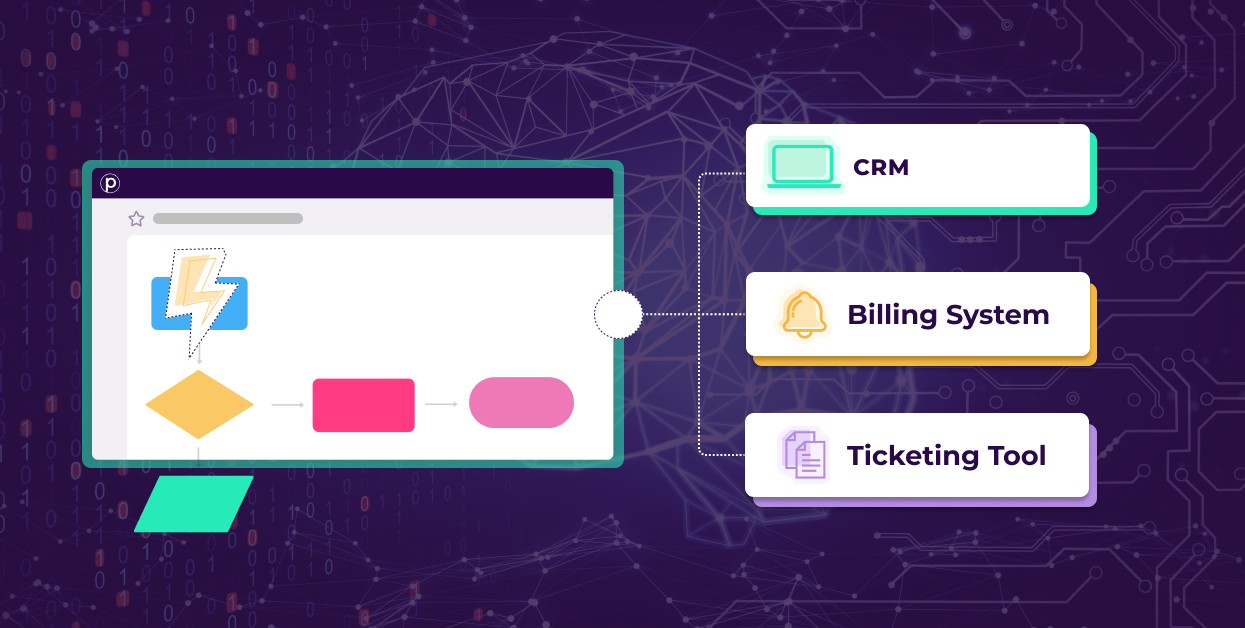
This is precisely the gap Procedureflow has spent the last several years building toward, and it’s why the company’s Agentic API, now in beta, is such a promising entry into this space. As a Human + AI knowledge infrastructure company, Procedureflow’s core product already turns scattered SOPs, compliance documents, and tribal knowledge into governed, visual, step-by-step workflows that contact center agents follow in real time, inside the platforms they already use (Salesforce, Genesys, AWS Connect, Microsoft Dynamics 365, NICE CXone, and others). That structured workflow layer, versioned, audited, and approved, is exactly the kind of “execution-ready knowledge” that AI agents need, and that raw document repositories simply can’t provide.
The Agentic API extends that same governed knowledge layer directly to AI systems, giving human and AI agents one shared, trusted source to follow. In practice, that means an AI agent, copilot, or voice assistant operating inside a contact center can be pointed at the current, approved version of a workflow (the exact steps, decision branches, and compliance guardrails a trained human agent would follow) instead of improvising an answer from an LLM’s general training or a loosely indexed knowledge base. As Procedureflow CEO Daniella DeGrace put it at the beta’s launch, the real barrier to enterprise AI has been trust rather than ambition, and giving AI agents the same approved, governed paths a company’s best people already follow is what lets AI move confidently from pilot to production. It’s a compelling reframe: governed execution, not just generation, is what turns a promising pilot into something enterprises can genuinely trust in front of customers.
For contact centers specifically, this positions Procedureflow as connective tissue between three things that are usually disconnected: the trusted knowledge an organization has already built and approved, the guided workflows human and AI agents both need to execute consistently, and the AI-driven action layer enterprises are racing to deploy. Rather than replacing existing AI investments, the Agentic API is designed to make them stronger, giving copilots, chatbots, and autonomous agents a governed source of truth to act from, complete with the audit trail regulated industries like banking, insurance, and utilities require. It’s an encouraging sign of where enterprise AI is headed: not humans versus AI, but human and AI agents working from the same trusted playbook.
How Organizations Can Prepare
Across every industry example above, the same short list of readiness factors shows up again and again:
Centralize and structure process knowledge before deploying agents. Data hygiene and process clarity are consistently cited as the top predictor of whether an agentic AI pilot survives past its first 90 days.
Start narrow and measurable. The highest-ROI early use cases (password resets, order status, claims triage, pre-adjudication document review) are high-volume, well-defined, and low-risk. Prove the model before expanding into judgment-heavy work.
Measure resolution, not just deflection. A dashboard full of deflected contacts can mask customers who never actually got their problem solved.
Build governance in day one. Versioned workflows, audit trails, and human-in-the-loop escalation aren't compliance overhead; they're what IBM's research shows makes an organization 5.4 times more likely to succeed with autonomous workflows in the first place.
Treat the knowledge layer as infrastructure, not a document repository. The organizations scaling agentic AI successfully are the ones that stopped asking "which model should we use" and started asking "is our operational knowledge structured well enough for any model to act on reliably."
The Bottom Line
Agentic AI isn't a future trend anymore; it's the operating reality enterprises across financial services, healthcare, utilities, software, and customer service are already building around in 2026. But the gap between the 80% of organizations experimenting with agents and the roughly 25 to 30% running them reliably in production is the single most important number in this whole story. That gap closes with governance and structured, trustworthy knowledge, not with a bigger model. That's the foundation Procedureflow has been building contact centers for years, and it's exactly what its Agentic API beta is designed to extend into the age of autonomous, AI-driven action. To see how it works, visit our features page.