Two forces are converging to transform banking CX at scale: artificial intelligence and structured knowledge management. Together they enable financial institutions to compress response times from minutes to milliseconds, deflect millions of routine inquiries without sacrificing quality, and surface the right information for each customer at every moment. This article examines the latest data, real-world deployments, and the strategic framework banks must adopt to compete in an era where CX is the primary differentiator.
Why CX Is Now the Primary Battleground in Banking
Banking is no longer competing on products alone. Interest rates converge, fees are regulated, and core banking features are commoditized across every major institution. What cannot be commoditized is experience.
Research from Deloitte confirms that banks with superior CX enjoy a 50% higher customer retention likelihood. Banks that actively optimize CX grow 3.2 times faster, yet only 2 in 10 do so consistently. 56% of dissatisfied customers leave silently. Zendesk finds 40% will switch if their preferred channel is not available. Maze Research shows 82% cite CX as the primary loyalty driver.
The State of AI Adoption in Banking CX
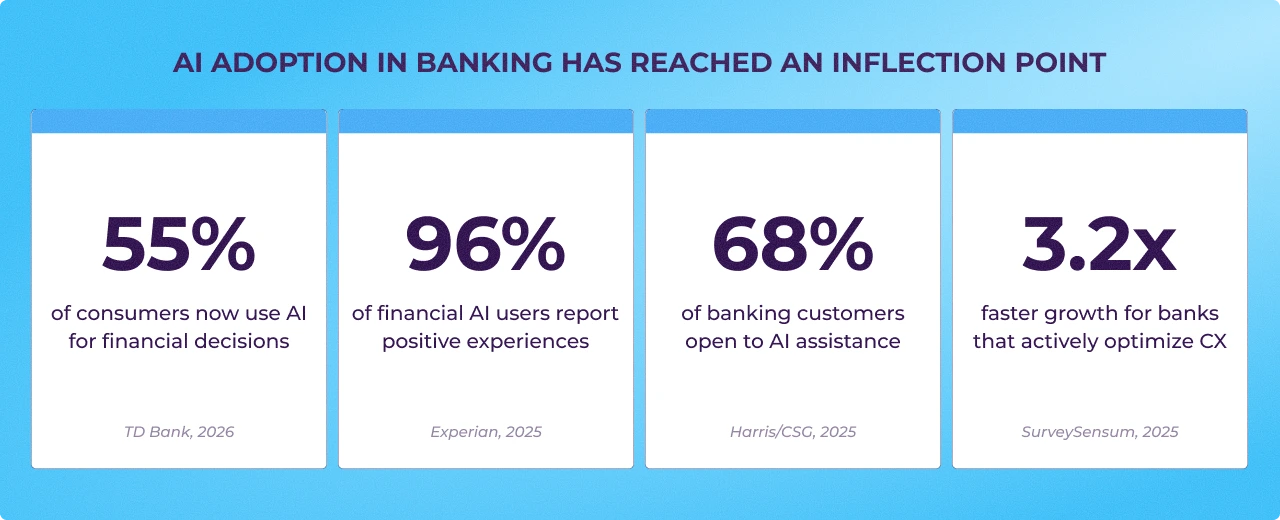
Consumer acceptance of AI in financial services has reached a decisive inflection point. The data from 2025 and early 2026 tells a remarkable story of acceleration.
TD Bank's 2026 survey of over 2,500 consumers found that 55% now use AI to aid their financial management decisions, up from just 10% a year earlier. JD Power puts the combined uptake rate at 73%. A 2025 Experian study found 96% of financial AI users report positive experiences. The Harris/CSG study shows 68% of banking customers are open to AI assistance, most comfortable with fraud alerts (36%), transaction explanations (30%), and billing queries (37%).
"Customers are comfortable with AI that informs and protects, that is the 30-to-37% comfort zone. But the moment AI shifts from 'here's what's happening' to 'here's what you should do,' comfort drops by a third."
Brandon Sailors, VP CX Strategic Accounts, CSG
Structured Knowledge: The Foundation AI Cannot Work Without
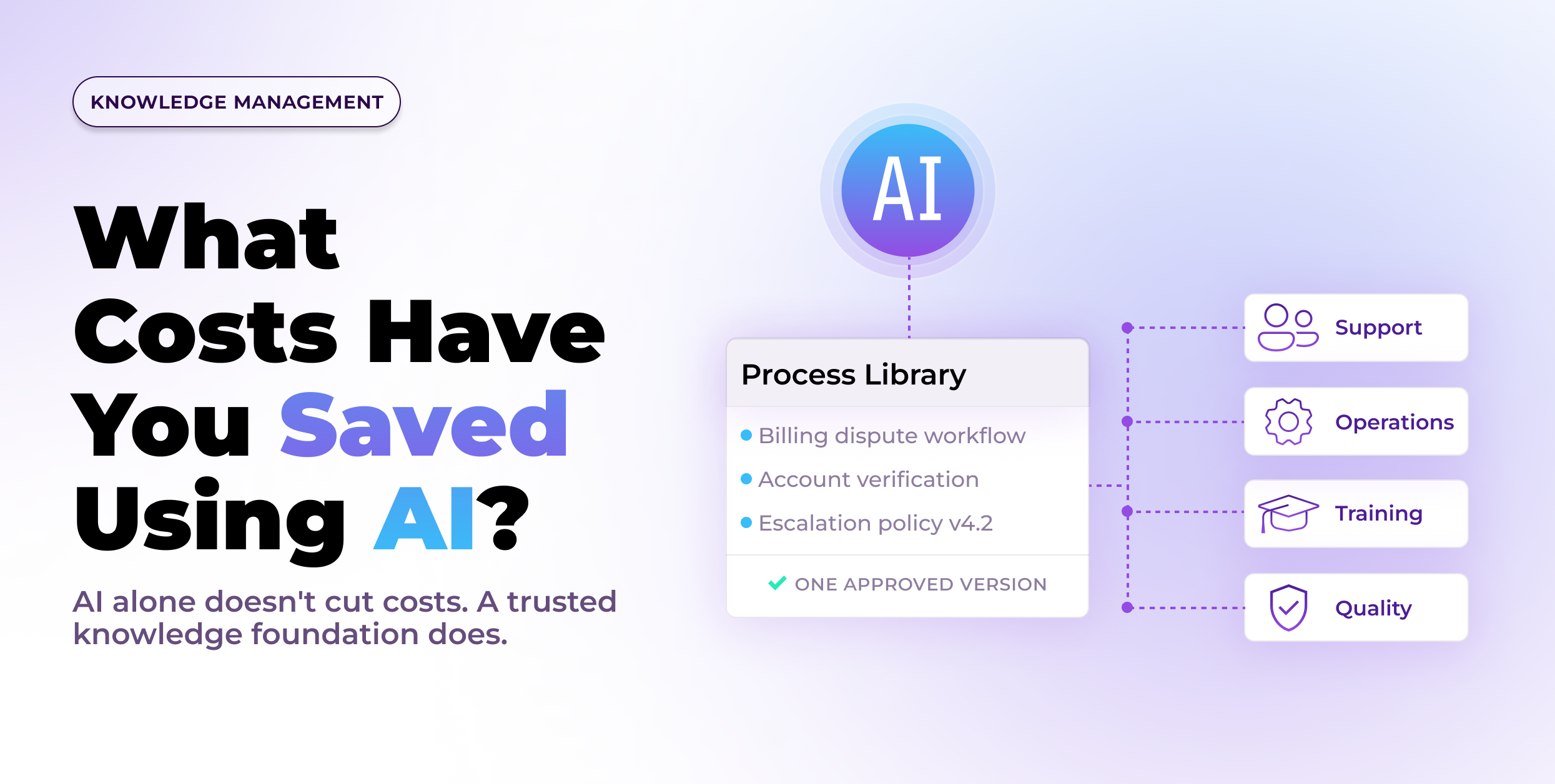
Every AI chatbot, virtual agent, or copilot is only as accurate as the knowledge it draws upon. General-purpose LLMs produce fluent, plausible responses, but enterprise banking demands accuracy, policy compliance, consistency, and auditability. A plausible-but-wrong answer to a product eligibility question is a compliance event, not just an inconvenience.
What Structured Knowledge Management Means in Banking
An AI knowledge base in a banking context is a centralized, intelligent system that uses semantic search, embeddings, RAG, and automated content understanding to store, retrieve, and surface organizational knowledge. Unlike static documentation, structured AI knowledge systems:
- Continuously ingest and categorize policy updates, regulatory changes, and product revisions
- Convert unstructured sources: transcripts, call recordings, emails, into searchable knowledge
- Monitor knowledge gaps and maintain version control for full auditability
- Return 300-400% ROI within the first year, with positive returns typically within 3-6 months
The Hidden Cost of Knowledge Fragmentation
Research shows 47% of organizations cite lack of deep customer data as their number one CX obstacle. When every channel draws from the same knowledge layer, mobile, web, branch, contact centre, AI chatbot, the 70% of customers who expect agents to have full context will finally find their expectations met.
When AI Meets Structured Knowledge: Real-World Results

Real-World Deployments Setting the Standard
Santander's AI next-best-action system drove a 22% increase in product-per-customer ratios, generating EUR 340M in incremental annual revenue (Santander Annual Report 2025).
Deutsche Bank built a structured knowledge layer for MiFID II requirements, reducing compliance costs by EUR 47M annually and improving reporting accuracy by 85%.
A major bank deployed a Microsoft Teams GenAI knowledge assistant, cutting policy lookup time from hours to seconds for frontline staff.
KYC, Credit Decisioning, and Fraud
- KYC processing: 5 days reduced to 4 hours per case via AI-assisted document extraction
- Credit decisioning: 48 hours reduced to real time for standard applications
- 40-60% of customer inquiries resolved by AI without escalation when backed by structured knowledge
- Juniper Research: AI fraud prevention saved the global banking sector USD 10.4 billion in 2025
EUR 340M Santander incremental annual revenue via AI + knowledge (2025) | EUR 47M Deutsche Bank annual compliance cost reduction via AI
Hyper-Personalization and Omnichannel Experience
Personalization
McKinsey: 71% of banking customers want personalized interactions and 76% are frustrated when personalization is lacking. Intelligent banking copilots, LLMs paired with structured product knowledge, answer questions like "Can I afford a vacation in July?" grounded in the customer's real financial data. BBVA and Capital One match customers with offers based on demonstrated needs, not demographics. While 73% of customers feel treated as unique individuals (up 39% from 2023), only 49% feel banks use their data beneficially, the biggest remaining opportunity.
Omnichannel
62% of bank clients want smooth channel transitions. Banks with strong omnichannel strategies retain 89% of customers. Bank of America is the benchmark: one unified knowledge layer serving desktop, mobile, and every touchpoint. The 70% of customers who expect complete context from agents get it through architecture, not effort.
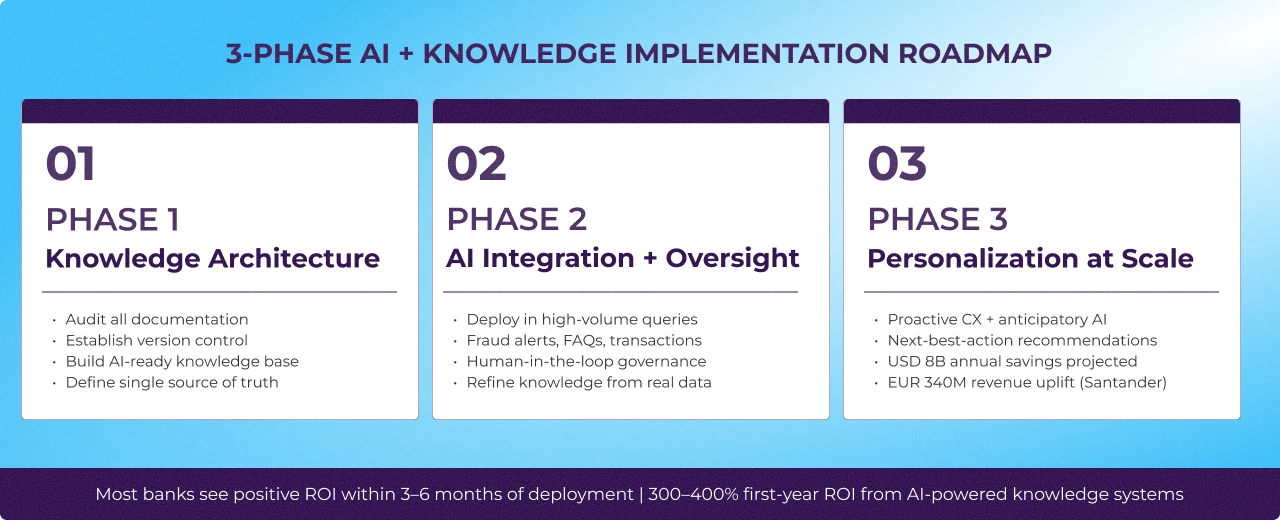
Implementation Framework: 3 Phases
The banks seeing the biggest CX gains from AI are not those with the most sophisticated models. They are those that built the most rigorous knowledge foundations first.
Phase 1: Knowledge Architecture Before AI Deployment
Audit all documentation for accuracy and currency. Build an AI-ready knowledge base: clear language, semantic formatting, consistent terminology, regular audit cycles. This is the foundation - everything else depends on it.
Phase 2: AI Integration with Human Oversight
Start with high-volume, low-complexity inquiries: balance queries, transaction explanations, product FAQs, fraud alerts. Maintain clear human escalation pathways. Treat every escalation as a knowledge gap to fill.
Phase 3: Personalization at Scale
Juniper Research projects USD 8B in annual savings from AI-powered support. But the bigger gains, like Santander's EUR 340M, come from AI-powered relationship deepening, not just cost reduction.
Trust, Compliance, and the Governance Imperative
Banking trust is built on accuracy and transparency. Every AI response must be traceable to a version-controlled source. The EU AI Act carries fines of EUR 35M or 7% of global turnover. DORA penalties reach EUR 10M or 5%. Structured knowledge management, with version control and source traceability, is the architectural solution that makes AI trustworthy in regulated banking.
"Being consistent, meeting clients where they are on their journey, that is how we maintain the human basis of trust that banking has always been built on."
Metrics That Matter: Measuring CX AI ROI
A structured approach to AI ROI in banking spans four domains:
Efficiency Metrics
- Handle time reduction: target 30-50% for AI-assisted interactions (Juniper Research)
- Deflection rate: percentage of inquiries resolved by AI without escalation
- First-contact resolution rate and agent productivity per hour
Revenue Metrics
- Product-per-customer ratio for AI-served segments
- Next-best-action acceptance rate, conversion value, and customer lifetime value uplift
Experience Metrics
- NPS differential for AI-assisted vs standard interactions
- Churn reduction and digital channel adoption rate
Compliance and Risk Metrics
- AI response accuracy against approved knowledge sources
- Fraud loss prevention: USD 10.4B saved globally in 2025 (Juniper Research)
- Bain (2025): 34% of cancelled AI programs would have achieved positive ROI within 6 months of cancellation, premature termination caused by inadequate measurement
Strategic Recommendations
For financial institutions at any stage of their AI and knowledge management journey, the following priorities represent the highest-leverage investments:
01: Audit and Structure Your Knowledge Foundation
Before any AI investment, structure and version-control all documentation into a single source of truth across every channel.
02: Deploy AI in High-Accuracy Use Cases First
Start with fraud alerts, FAQs, and transaction queries, where the 30-37% comfort zone is proven and accuracy is validatable at scale.
03: Unify Knowledge Across All Channels
Mobile, web, branch, contact centre must all draw from one knowledge layer. Siloes destroy the omnichannel promise.
04: Keep Humans in the Loop
AI augments trust, not replaces it. Customers want human expertise for complex decisions. Design escalation as a feature, not a fallback.
05: Measure Before, During, and After
Define KPIs across efficiency, revenue, CX, and compliance before deployment. Bain's 2025 analysis found that 34% of cancelled AI programs were on track for positive ROI, poor measurement killed them.
The Road Ahead: What Comes Next
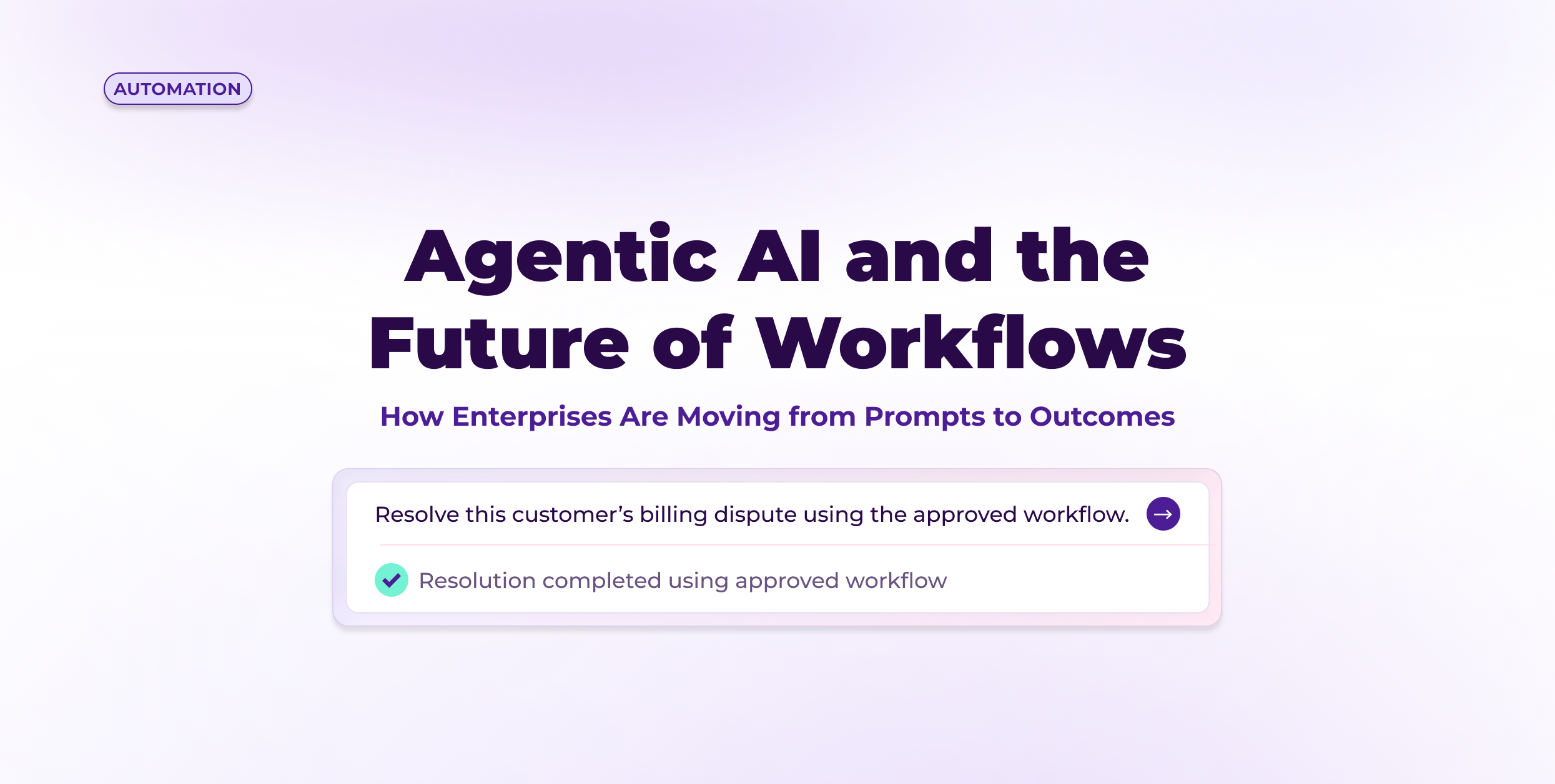
Statista projects online banking users will grow from 66% to 79% of the global population by 2029. The global CX market will reach USD 57.67B by 2026. The next wave will be defined by agentic AI: systems that orchestrate multi-step workflows on the customer's behalf, retrieving mortgage product details, running affordability calculations, and scheduling a human advisor consultation, all within one conversational exchange.
The banks that will lead this wave are those that invest in the knowledge foundation now, build AI governance as a core competency, and treat every customer interaction as both a service delivery moment and a knowledge capture opportunity.
Conclusion
The convergence of AI and structured knowledge management is the present competitive reality in banking. From Santander's EUR 340M revenue uplift to Deutsche Bank's EUR 47M compliance savings, from TD Bank's 55% AI adoption surge to the industry-wide USD 10.4B in fraud losses prevented, the ROI of this convergence is real, measurable, and compounding.
Build the knowledge foundation first. Deploy AI with governance. Scale toward proactive, personalized CX. Measure rigorously. Maintain the human connection. That is the formula - and the banks executing it today will define the industry's CX landscape for the next decade.