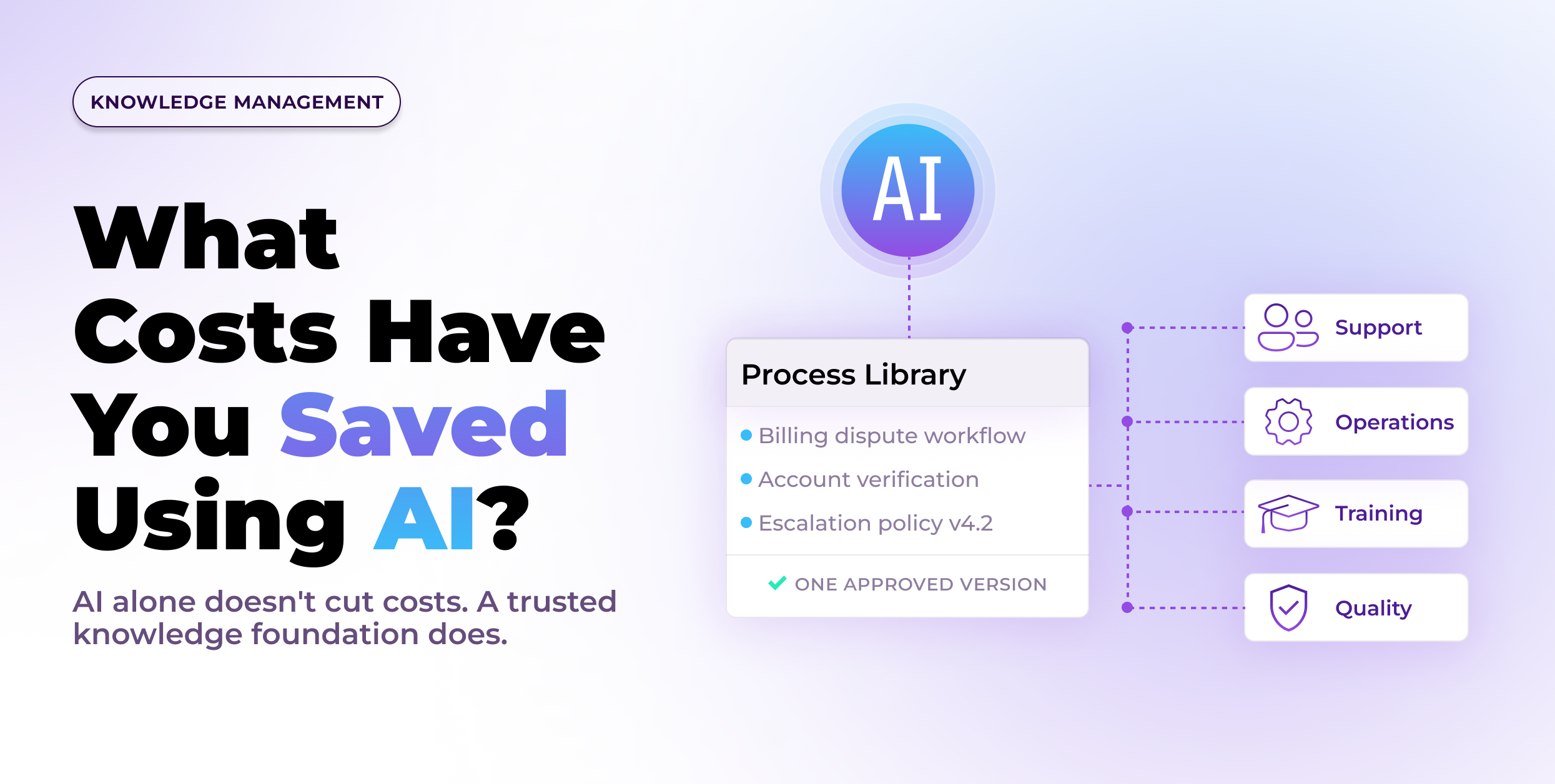
Only 27% of contact centers are actively using AI within knowledge management, the very foundation every other AI capability depends on.
At the 22nd Annual Customer Contact East: A Frost & Sullivan Executive MindXchange in Fort Lauderdale, Jaclyn Lo, Director of Customer Success at Procedureflow, facilitated the ThinkTank session AI Ready Knowledge: Powering Better Customer Experiences for Human and Digital Agents. The session drew a full room of CX leaders wrestling with one of the most urgent questions facing the industry today:
Is your contact center knowledge foundation actually ready for AI?
The answer, for most organisations, is more complicated than they would like to admit. Jaclyn was joined in the session by leaders Adrian Gonzalez, Manager Customer Care Center, and Carlton Coleman, Sr. Manager Customer Contact Centers, both of Southern Company Gas, who brought operational perspective to the discussion.
Why Knowledge Is the Foundation Every AI Investment Depends On
MindXchange East 2026 made one thing clear: the industry is at an inflection point. The organisations that come out ahead will not necessarily be the ones who deployed AI first. They will be the ones who built the infrastructure that lets AI actually work.
Every conversation at the event, from headliner sessions on AI governance to panels on managing corporate expectations, returned to the same truth: technology is not the hard part. The foundation underneath it is.
The room returned to the same destination from every direction: a single source of truth, fully accurate, built to power both people and AI. The organisations that build that foundation now will not just be ready for AI. They will be the ones that make AI work.
Knowledge is that foundation.
The AI Adoption Gap Nobody Is Talking About
Most contact centers have knowledge. What they lack is structured, governed, trustworthy knowledge. That gap, invisible to human agents who work around it daily, becomes a scaling liability the moment AI is introduced.
The energy in the room was immediate. Leaders from utilities, financial services, hospitality, and healthcare arrived carrying the same tension: they are being asked to deploy AI at scale, yet something feels unstable underneath. That something, almost universally, is knowledge.
The numbers tell a clear story:
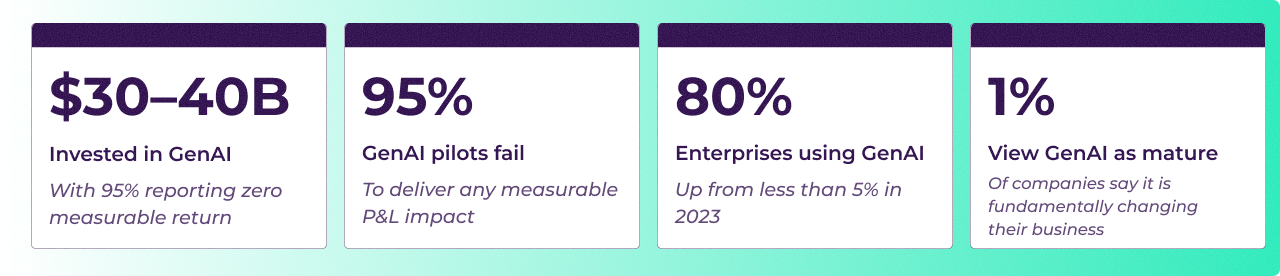
Jaclyn opened by asking participants to get honest about where their organisations actually stand. Most teams have knowledge. Plenty of it. What they lack is knowledge that an agent, human or digital, can act on confidently and consistently every time. As one theme crystallised early:
Get your business on a single source of truth.
That phrase became a refrain throughout the day.
The provocation Jaclyn set at the outset:
AI does not fill gaps in your knowledge foundation. It amplifies them.
“An outdated procedure gets coached out of a human agent. An AI scales that same error across thousands of interactions before anyone notices.”
Jaclyn Lo, Director of Customer Success, Procedureflow
If process documentation is inconsistent, outdated, or siloed in the institutional memory of tenured agents, deploying AI on top of that foundation does not solve the problem. It scales it. The room surfaced the pain points immediately: archaic knowledge bases, search that does not return what people need, content that has the bones of a process but lacks the full navigation and decision logic to be actionable, version sprawl, and the persistent challenge of change management.
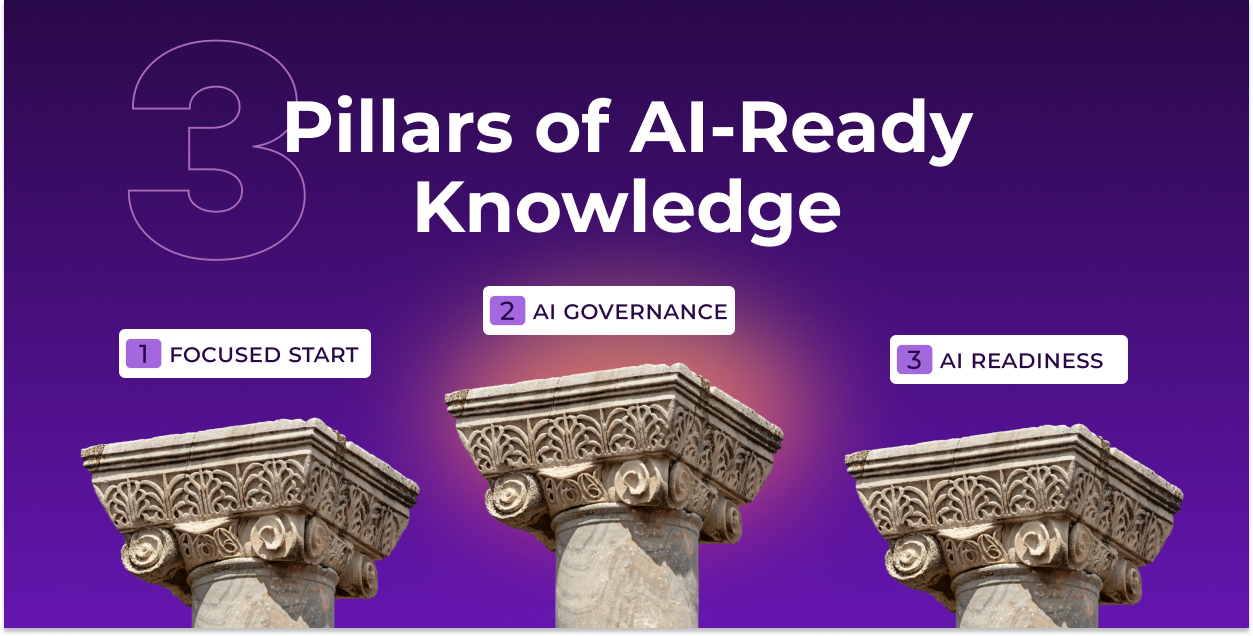
The Three Pillars of an AI-Ready Contact Center Knowledge Strategy
1. Start Focused, Not Comprehensive
Begin with your highest-volume, highest-variability contact types. These are the interactions where knowledge inconsistency costs the most. A focused proof of concept in two or three high-impact areas builds momentum, demonstrates ROI, and earns the executive buy-in needed to scale.
One of the most common barriers to action is the sheer scale of the challenge. Contact centers are complex, with thousands of call types, hundreds of processes, and constantly shifting policies. The instinct is to document everything at once. That instinct leads to stall.
Carlton and Adrian walked participants through a sharper approach: identify the interactions where inconsistency costs the most in handle time, escalation rates, and customer satisfaction. Nail those first. The proof of concept creates momentum and executive buy-in that makes broader expansion possible.
| Readiness Criteria | Why It Matters for AI |
|---|---|
| Is this procedure current? | AI applies outdated content at scale. A human agent catches the error. An AI replicates it across thousands of interactions. |
| Is it machine-readable and structured? | AI cannot interpret loosely formatted or narrative-style documentation. It needs logical structure to extract and apply the right answer. |
| Does it have clear decision logic? | Having the bones of a process is not enough. AI needs explicit if/then paths, not implied ones that experienced agents fill in from memory. |
| Has it been validated by SMEs? | Unvalidated content trusted by AI becomes unvalidated content delivered to customers at volume. The downstream cost is significant. |
| Is it free from version-itis? | Multiple versions of the same process create conflicting signals. AI cannot adjudicate between them. One source of truth is non-negotiable. |
| Does it account for exceptions? | Standard paths are only part of the picture. If exceptions are undocumented, AI will default to the standard path even when it should not. |
A point that resonated strongly with the room: documents might have the bones of a process, but do they have the full navigation, the full decision logic, the clear path for a new agent on a complex call? For organisations running new hire cohorts, this gap is felt acutely. New classes consistently struggle to navigate complex calls precisely because the knowledge exists in some form but was never built to guide decision-making under pressure.
2. Governance Designed for AI, Not Just for People
AI-ready governance requires clear ownership, defined review cadences, version control, and escalation paths for edge cases. Someone must be accountable for the knowledge system as a whole, not just their slice of it. Without that, drift becomes a compounding liability at scale.
This was the pillar that generated the most debate, in the best possible way.
Most organisations have some form of content governance. What they do not have is governance designed with AI in mind. The distinction matters enormously.
When a human agent follows an outdated procedure, a supervisor can coach them. When an AI system follows an outdated procedure, it scales the error across thousands of interactions before anyone notices. The stakes are categorically different.
A theme that surfaced early and persisted throughout the day: EX equals CX. The experience agents have navigating knowledge directly shapes the experience customers receive. Governance is not an operational concern held at arm's length from CX strategy. It is a customer experience concern.
“Build your knowledge foundation to guide people well, and you build it well for AI. The knowledge that helps agents navigate with confidence is the same knowledge that makes AI trustworthy.”
Jaclyn Lo, Director of Customer Success, Procedureflow
Jaclyn challenged the room to reframe governance not as a compliance obligation but as an enabler. Clear ownership. Regular review cadences. Version control. Escalation paths for customer variability. These are not bureaucratic hurdles. They are the structures that make it safe to trust the knowledge, and by extension, safe to trust the AI that draws from it.
The group surfaced the question that arises in almost every organisation: who actually owns knowledge governance? The answer the room landed on: it cannot sit with one team. Training owns part of it. Operations owns part. Quality owns part. But someone must be accountable for the system as a whole. A knowledge steward or governance lead who ensures everything holds together. Carlton and Adrian shared how they operationalized knowledge by bringing their stakeholders together and defining clear ownership roles from the start.
On the role of Quality specifically, the conversation shifted something important. In many organisations, quality has historically felt punitive to frontline teams: errors flagged, scores issued, little forward guidance offered. The room agreed on a more productive model. Bring QA to the table as a knowledge partner. When agents get it wrong, Quality points them back to the resource rather than marking the error in isolation. That shift turns quality from a deterrent into a reinforcement loop that builds genuine trust in the knowledge system over time.
3. Knowledge Readiness Standards: Define AI-Ready Before You Deploy
Knowledge readiness standards are the criteria process documentation must meet before AI can draw from it reliably: current, structured, machine-readable, with clear decision logic, and validated by subject matter experts. Without this bar, AI-ready is a marketing phrase. With it, it becomes a measurable goal.
The final pillar is the one most organisations skip. They deploy AI first and discover the knowledge gaps afterward.
Jaclyn introduced the concept of knowledge readiness standards: a defined quality bar that process documentation must clear before it can be trusted as a source for AI-assisted or AI-driven agent support.
A point worth sitting with: prompt engineering only works if the knowledge it draws on is accurate, complete, and logically structured. What are people going to ask? How do we get them the right answer? Those questions cannot be answered well if the underlying knowledge has not been built to answer them.
What the Room Told Us
The participants across utilities, financial services, hospitality, and healthcare shaped the conversation around five consistent themes:
| # | Theme | Key Insight |
|---|---|---|
| 1 | Foundation first | Moving fast on a weak knowledge foundation is worse than building it right. Every organisation in the room had felt the cost of the alternative. |
| 2 | One foundation for all | Human-facing and AI-facing knowledge depend on the same knowledge principles to be successful. Treating them as separate creates inconsistencies that surface at the worst moments. |
| 3 | Change management = technology | Trust in the knowledge system, and then the AI built on it, requires deliberate culture work: champions, detractors, and team effort from the start. |
| 4 | Close the feedback loop | Agents contribute knowledge improvements only when they see their feedback land. Make it visible. Make agents feel heard. The system becomes self-improving. |
| 5 | Plan for AHT to rise | When AI handles routine calls, human agents handle complex ones. Rising AHT signals the AI is working. Plan for it or risk misreading the data. |
The Business Case Is Concrete
The numbers make the stakes hard to ignore. Industry analysis suggests that just six or seven agents consistently navigating incorrect processes can translate to nearly a million dollars in operational cost, the equivalent of ten seconds on average handle time.
| Statistic | Source | What It Means for Knowledge Strategy |
|---|---|---|
| $80 billion | Gartner | Projected global reduction in agent labour costs from conversational AI. Capturing it requires a foundation that is already AI-ready. |
| +14% / -9% | McKinsey | Gen AI-enabled agents achieved 14% more issue resolutions per hour and 9% less time per interaction but only where knowledge was operationally ready. |
Now that data exists to bridge this gap, the conversation changes entirely. The question shifts from whether to invest in knowledge management to where to start.
Is Your Contact Center Knowledge Foundation AI-Ready? A Quick Audit
Use this five-question audit to benchmark where your organisation stands today. Be honest. The gaps you identify here are the gaps AI will amplify tomorrow.
| Question | Yes | In Progress | Not Yet |
|---|---|---|---|
| Do you have a single, authoritative source of truth that all agents, human and AI, draw from? | ☐ | ☐ | ☐ |
| Is there a named person accountable for the health of your knowledge system as a whole? | ☐ | ☐ | ☐ |
| Can a new hire navigate your three highest-volume contact types without calling the senior line? | ☐ | ☐ | ☐ |
| Do you have a defined review cadence that ensures your process documentation stays current? | ☐ | ☐ | ☐ |
| Have you established what AI-ready means for your organisation in writing, with measurable criteria? | ☐ | ☐ | ☐ |
Score Legend:
- 5 x Yes: Your foundation is strong. The priority now is maintaining governance rigour as AI scales.
- 3-4 x Yes: You have the foundations of a governance culture. Define your readiness standards and name your knowledge owner before your next AI investment.
- 0-2 x Yes: Your knowledge foundation needs work before AI can deliver results. Start with Pillar 1: identify your top three contact types and build from there.
Want a full scored assessment? Take Procedureflow’s free Knowledge Readiness Test and get a personalised score with specific recommendations for your contact center.
If you are a CX leader thinking about where to start or feeling the pressure to scale AI faster than your knowledge management can support, Jaclyn and the Procedureflow team help organisations close exactly that gap every day. Book a demo or explore Procedureflow for contact centers.
About Jaclyn Lo
Jaclyn Lo is Director of Customer Success at Procedureflow, where she operates at the intersection of knowledge management, contact center operations, and AI-readiness. With extensive experience optimising customer experience, accelerating digital adoption, and leading large-scale change across contact centers, she brings a practitioner's understanding of what frontline teams need to perform with confidence.
Her work is grounded in a single conviction: strong knowledge foundations are the engine behind confident agents, consistent service delivery, and AI systems that genuinely add value. It is a conviction she carried into every conversation at MindXchange East.
Connect with Jaclyn on LinkedIn.