Your Agents Are Not the Problem. Your Training Infrastructure Is.
Let us be direct about something most contact center leaders are reluctant to say out loud.
The agent performance gap in your organization is probably not a hiring problem. It is not a motivation problem. And it is almost certainly not a training problem in the way you have been thinking about it.
It is a knowledge infrastructure problem. And the distinction matters enormously, because one of those problems gets solved by running more training sessions, and the other gets solved by fundamentally rethinking how operational knowledge reaches the people who need it.
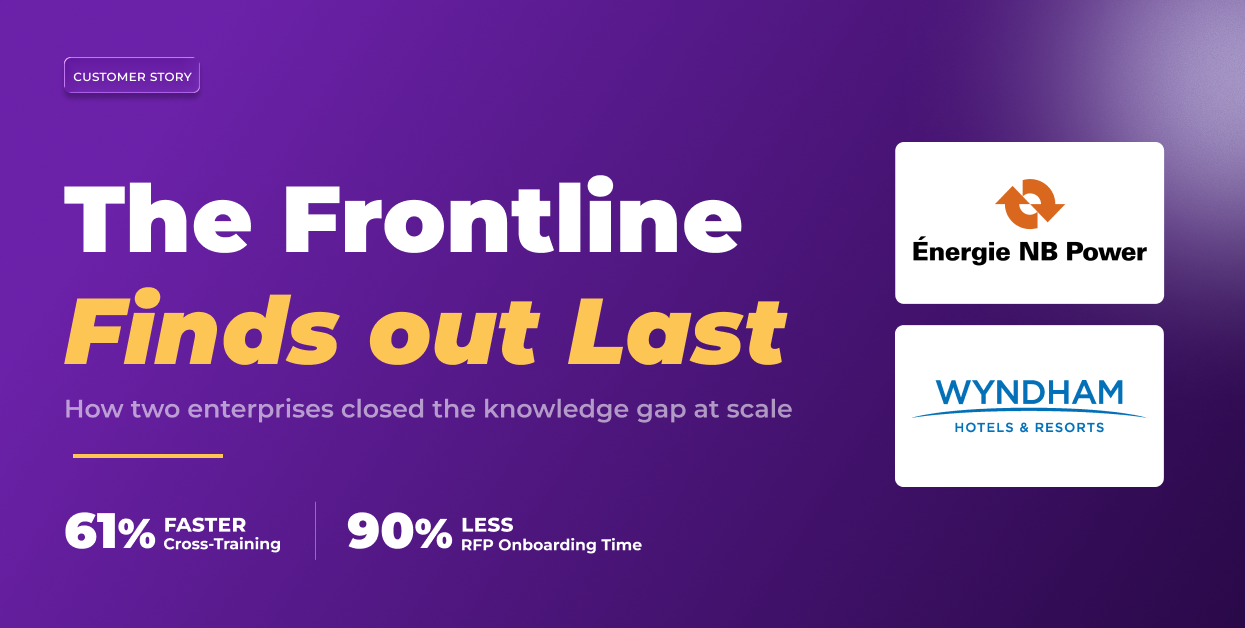
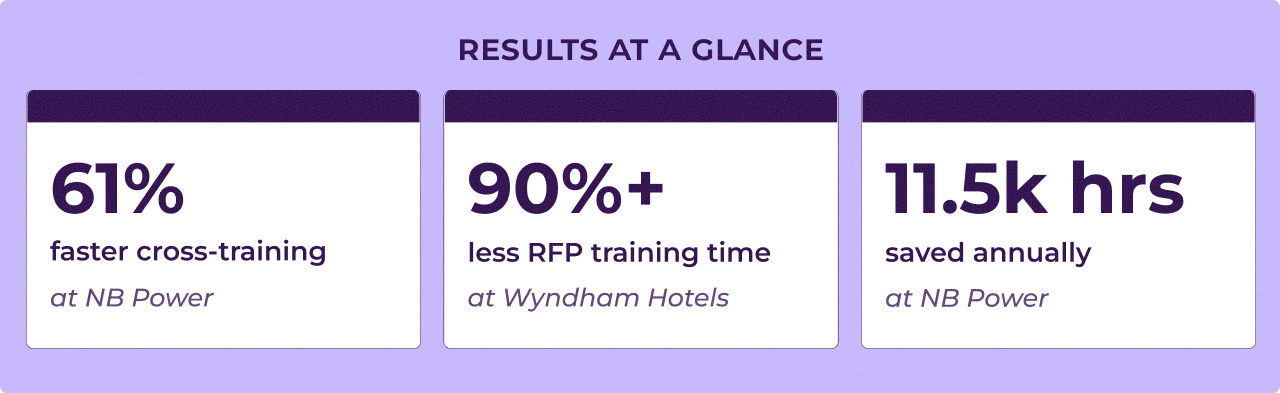
NB Power and Wyndham Hotels and Resorts figured this out. What they did next cut cross-training time by 61% and eliminated over 7,000 mentor assist calls a year. More importantly, it changed what great performance looks like in their organizations and what it costs to sustain it.
The uncomfortable truth about what training costs
When leaders' audit training is spent, they look at the obvious numbers. Classroom hours. Trainer salaries. Onboarding timelines. These are real costs and they deserve scrutiny.
But they are not where the money actually goes.
Most of the training-related costs in a contact center are invisible on a budget line. It accumulates in four places that almost nobody measures:
- Dependency on senior staff. Every time a newer agent reaches the mentor to assist button, a high-value employee stops doing high-value work. At NB Power, this was happening 7,000 times a year with 11,500 hours of senior capacity redirected from customers to internal support.
- Extended time for independence. An agent who cannot take a live call unsupported is a cost center, not a revenue asset. NB Power's cross-trained agents were not cleared for live calls until Day 13. That is almost two weeks of supervised, subsidized performance.
- Silent process drifts. Procedures change. Documentation does not always follow. And when it does, there is no guarantee the update reaches all 200, 500, or 700 people on the floor. The gap between the official process and what agents are doing widens quietly, expensively, often invisibly until a compliance review or customer escalation makes it visible.
- Inconsistent outcomes at scale. Two agents. The same customer situation. Two different answers. This is not an individual performance failure. It is what happens when organizations rely on memory and informal knowledge transfer instead of structured, governed process guidance.
For NB Power, the stakes of getting this wrong are not abstract. The utility serves customers across New Brunswick who call about power emergencies, disconnections, and safety situations. When the margin for error is zero, the cost of knowledge infrastructure failure is not measured in QA scores. It is measured in outcomes that nobody wants to be responsible for.
This is the context in which Procedureflow was implemented. Not as a training tool. As a knowledge infrastructure decision.
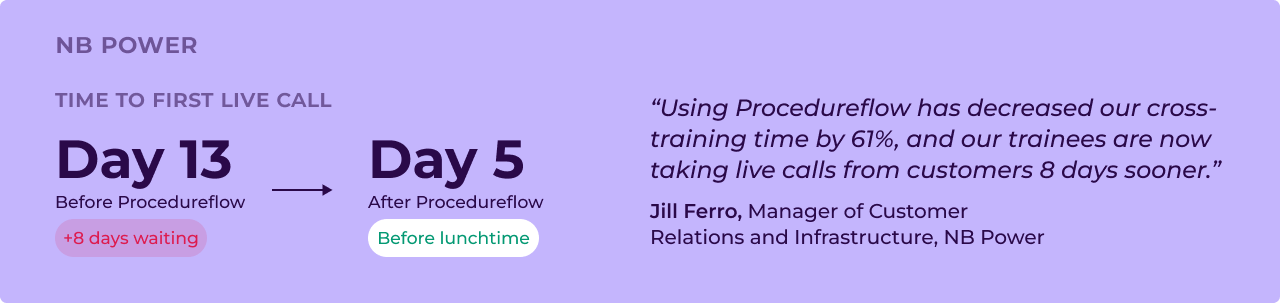
“Using Procedureflow has decreased our cross-training time by 61%, and our trainees are now taking live calls from customers 8 days sooner.”
Jill Ferro, Manager of Customer Relations and Infrastructure, NB Power
What the numbers actually show
| Metric | Before | After Procedureflow |
|---|---|---|
| Days to first live call | Day 13 | Day 5 (by lunch) |
| Cross-training time | baseline | 61% faster |
| Mentor assist calls / year | 7,000+ | eliminated |
| Hours saved annually | 0 | 11,500 |
| Trainer preparation time | baseline | 50% less |
The update problem: where most operations quietly break
Here is a challenge worth sitting with.
Your organization changed a procedure last month. How confident are you, right now, that every agent on your floor is working from the updated version?
If that question makes you uncomfortable, you have identified your most significant operational risk. Not the initial training. The update.
Most contact centers have reasonably good onboarding. What they have not solved is the infrastructure for change. A policy shifts. A regulation updates. A system gets patched. Someone updates the SharePoint folder, sends an email, or runs a quick team meeting. And then the organization assumes the knowledge has landed. It rarely has. Not completely. Not consistently.
Wyndham Hotels and Resorts operates at a scale that makes this problem vivid. Managing approximately 2,000 standard operating procedures across more than 700 contact center employees in Saint John, New Brunswick, the organization understood that knowledge drift was not a possibility. It was a daily reality. The question was whether it would remain invisible or become manageable.
Every autumn, the stakes crystallize. RFP season brings the full weight of global corporate travel contracts to a team that must navigate the Global Distribution System with precision. Agents who are working from outdated procedures do not just underperform. They create exposure with accounts that represent significant revenue and long-term relationships.
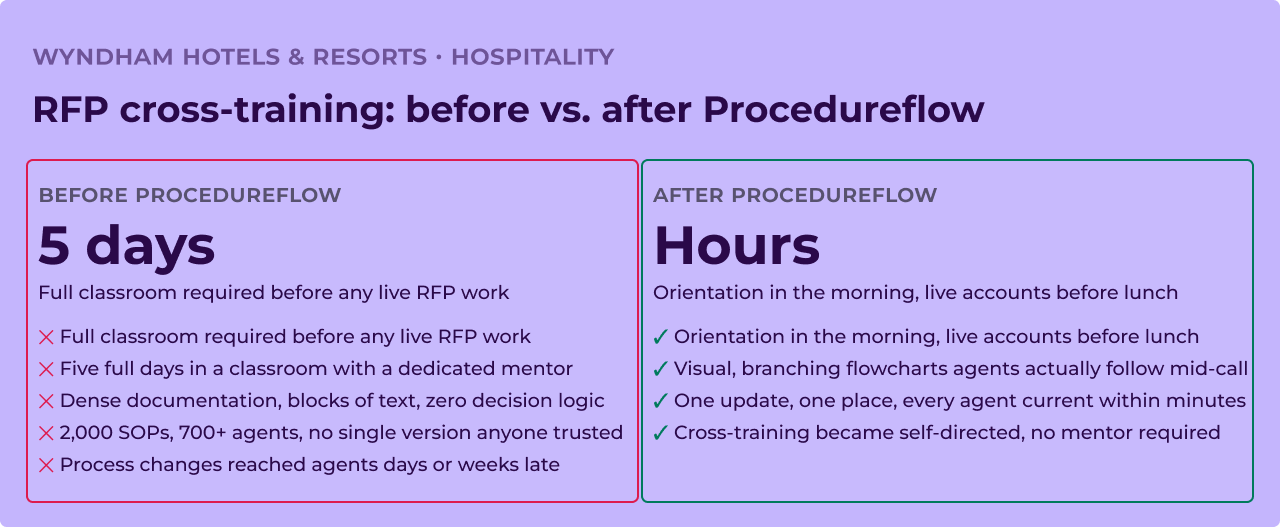
Before Procedureflow, preparing a single agent for RFP work required five days in a classroom with a dedicated mentor. The training itself was solid. But every time a process changed after that classroom session, the organization was betting that informal communication would close the gap between official policy and floor reality. That is a bet, no serious operation should be comfortable making.
What Procedureflow changed for Wyndham was not the quality of the knowledge. It was the infrastructure through which that knowledge reached agents, and crucially, the way it updated. One change in one place. Every agent is current within minutes. No assumptions. No gaps.
For NB Power, the shift was equally structural. Decision logic was embedded directly into each workflow. When an agent is on a call with a customer facing disconnection, the system does not present information and asks the agent to interpret it. It presents the next step, based on the specific situation. The cognitive load drops. The consistency rises. The mentor assist button becomes redundant.
The mentor assist button did not disappear because agents stopped needing guidance. It disappeared because guidance became part of the system rather than a person.
Consistency is a strategic capability.
The operations leaders who have thought most carefully about contact center performance have reached a conclusion that challenges how most organizations frame their investment decisions.
Consistency at scale is not a quality assurance outcome. It is a strategic capability. And it is one of the most defensible competitive advantages an organization can build, because it is genuinely hard to replicate without changing the underlying infrastructure.
Consider what consistency actually requires. It demands that every agent, on every call, regardless of tenure or shift or channel, has access to the same current, accurate process of guidance. It demands that when something changes, the change propagates to all of them simultaneously. And it demands that the organization verify this, not through sampling and hope, but through governance.
This is a different ambition than most contact center training programs are designed to achieve. Training programs produce knowledge for people. Knowledge infrastructure produces consistent execution across people. The first degrades over time. The second scale.
NB Power understood this when they described what Procedureflow gave their QA team: an objective standard. Not a rubric derived from a trainer's best judgment. A documented, current, auditable flow that every agent was supposed to follow. Performance variance became visible. Coaching became specific. The organization stopped debating what the right process was and started measuring adherence to it.
“We love Procedureflow because it reduces ramp time and employees can start doing work right away.”
Wyndham Hotels and Resorts operations team
For Wyndham, the five-day RFP training became a morning orientation followed by live work before lunch. The model shifted from "train until ready" to "guide while doing." The result was not just faster onboarding. It was an organizational capability that absorbs change, scales capacity, and maintains quality simultaneously.
The compounding effects leaders rarely anticipate
- Senior staff capacity. When agents do not need mentors to navigate routine complexity, senior employees redirect toward genuinely high-value work. This is not a marginal benefit. At NB Power it translates to 11,500 recovered hours annually.
- Operational resilience. With faster cross-training and broader agent competency, workforce planning becomes less fragile. A sick day or leave of absence stops being a coverage crisis and becomes a staffing adjustment.
- Governance confidence. QA teams gain something they rarely have in traditional environments: an objective, current, and process standard against which every interaction can be measured. The conversation shifts from "what should agents do" to "are agents following what we know works."
- Agent confidence. This one is underrated. Agents who know the answer are available, current, and trusted do not hesitate to be hedged. They do not escalate unnecessarily. They serve with the kind of certainty that customers recognize and remember.