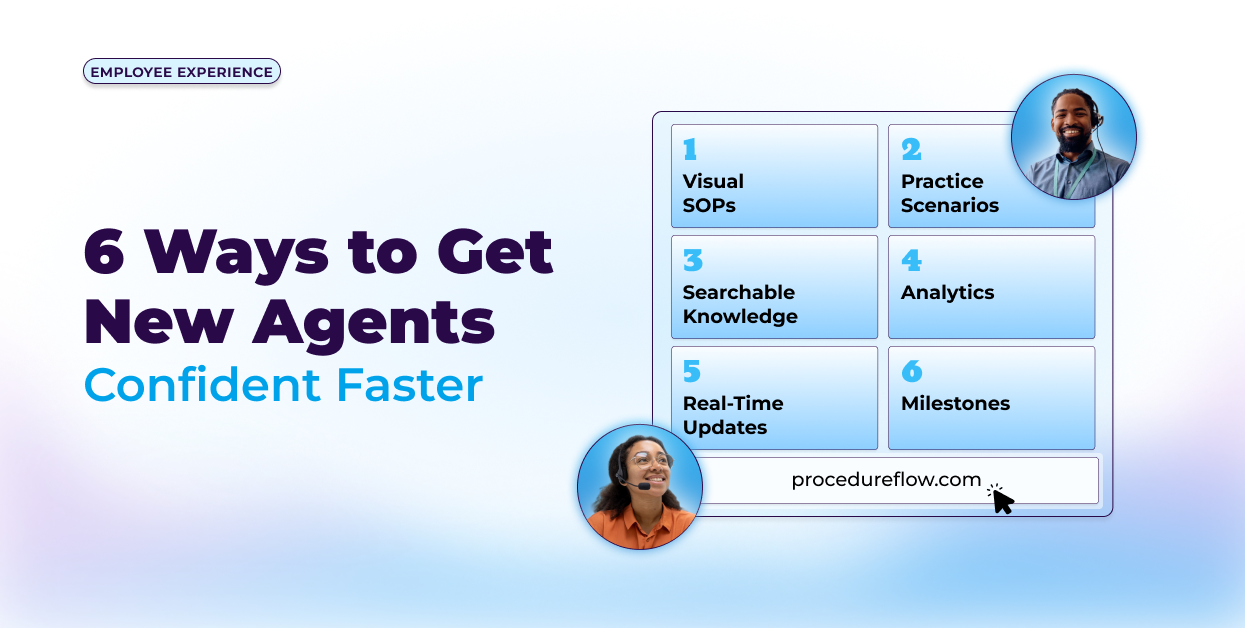
The six most effective strategies for accelerating contact center agent onboarding are:
- transitioning from static documentation to visual, interactive SOPs;
- building pre-live scenario practice into the training journey;
- making procedural knowledge instantly searchable during live interactions;
- maintaining procedures in real time with automated agent notifications; and
- establishing structured milestones that give agents a visible path to full productivity. Organizations that implement these strategies consistently report faster ramp times, stronger agent retention, and measurable improvements in early-tenure customer experience.
For operations and training leaders in the contact center space, the first 90 days of an agent's tenure represent both the greatest risk and the greatest opportunity. It is the window in which confidence is built or eroded, in which the decision to stay or leave is quietly made, and in which the quality of onboarding becomes directly visible in customer experience metrics.
Most contact centers are losing that window. Traditional onboarding relies on static documentation, passive observation, and classroom training that bears little resemblance to the complexity of a live call environment. The predictable outcome is agents who feel underprepared, supervisors stretched thin by avoidable escalations, and turnover rates that make a difficult problem exponentially harder to solve.
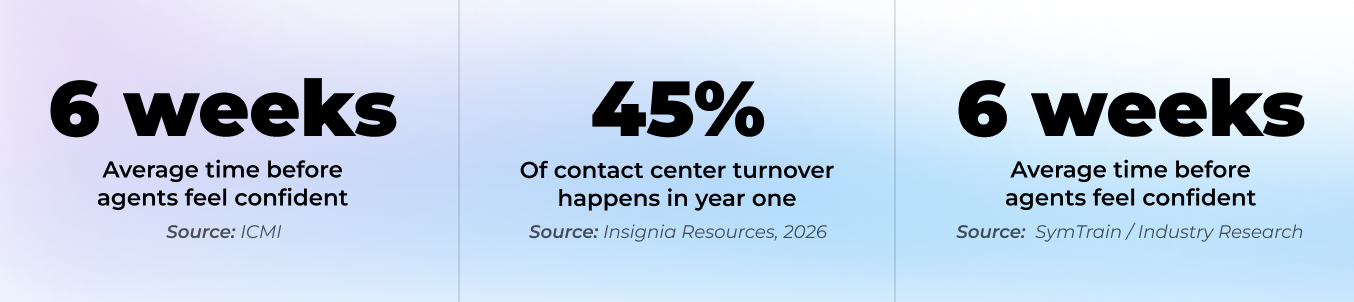
Industry research consistently shows that onboarding and proficiency ramp-up remain major operational challenges for contact centers. Procedureflow’s own research notes that new agents can take up to a year to reach full proficiency, while average agent tenure sits at just 11 months. At the same time, annual contact center turnover rates continue to range between 30 to 45% annual agent turnover, with some sectors reporting rates as high as 85%. McKinsey research estimates the true cost of replacing a single agent at $10,000 to $20,000 when factoring in recruitment, training, and lost productivity during ramp-up. For a 100-agent contact center operating at industry-average turnover, that translates to annual attrition costs exceeding $700,000. The operational case for rethinking onboarding, knowledge accessibility, and agent support is unambiguous.
What follows are six evidence-based strategies that leading contact centers are using to close the confidence gap, reduce early attrition, and build the kind of agent capability that sustains both customer satisfaction and business performance.
1. Transition from static documentation to visual, interactive SOPs
The operational challenge: knowledge that cannot be accessed is knowledge that does not exist
The instinct to document everything is correct. The method of documentation is where most contact centers fall short. Lengthy Word documents and multi-page PDF manuals may capture institutional knowledge comprehensively, but they are architecturally unsuited to the demands of a live call environment. An agent navigating a complex billing dispute cannot pause to search for a 60-page reference guide. The cognitive overhead alone undermines performance.
Visual SOPs (Standard Operating Procedures) restructure that same knowledge into guided, decision-tree flows that agents can navigate in real time, one step at a time, without needing to hold the full procedure in working memory. The result is not just faster access to information. It is a fundamental shift in how procedural knowledge is applied: from recall under pressure to guided execution with confidence.
ICMI research highlights that relatively straightforward changes to how procedures are structured and delivered can reduce new hire ramp-up time by as much as 75%, simply by making knowledge more accessible and navigable during live interactions. Procedureflow was purpose-built for this transition, converting complex operational processes into intuitive, interactive flows that agents can follow live during customer interactions from their first day through to full tenure.
Procedureflow insight: Organizations that build SOPs as interactive decision trees see agents navigating live calls with measurably greater accuracy during their first weeks, because the procedure itself does the cognitive work.
2. Build pre-live scenario practice into the onboarding journey
The operational challenge: the gap between classroom readiness and live call readiness
Shadowing experienced agents is a common onboarding staple, and it has genuine value. But observation is not preparation. An agent who has watched twenty calls handled by a senior colleague has not yet demonstrated that they can handle one themselves. The transfer of knowledge from observed to executable is not automatic, and the contact center environment offers very little tolerance for that gap.
The most effective bridge is structured scenario practice conducted within the actual tools, procedures, and systems agents will use on the floor. When new hires work through representative call types, such as account changes, complaint handling, or policy exceptions, using live procedures rather than simulated ones, two things happen simultaneously: procedural familiarity develops, and confidence forms around competence rather than assumption.
Organizations that implement scenario walkthroughs as a mandatory onboarding gate consistently report a smoother transition to live queues, fewer avoidable escalations in the first 30 days, and higher agent-reported readiness. The approach also surfaces knowledge gaps early, when they are inexpensive to address, rather than allowing them to manifest as errors during live customer interactions.
Procedureflow insight: Assigning scenario walkthroughs before an agent takes their first live call converts theoretical training into demonstrated capability. Completion data also gives supervisors an early, objective signal of where additional support is needed.
3. Make procedural knowledge instantly accessible during live interactions
The operational challenge: hold time as a symptom of knowledge architecture failure
Extended hold times during the early weeks of an agent's tenure are rarely a motivation problem. They are a knowledge architecture problem. When an agent cannot locate the correct procedure within a few seconds, the path of least resistance is to place the customer on hold and ask a supervisor, or worse, to guess. Metrigy research indicates that agents' inability to access information quickly is among the primary drivers of both extended handle times and agent frustration, both of which are significant contributors to early-tenure attrition.
Organizations that invest in making procedural knowledge instantly searchable during live interactions, through keyword-tagged procedures surfaced via real-time search or context-triggered workflows, see measurable reductions in average handle time among new hires, without sacrificing accuracy. The knowledge infrastructure that supports a 10-year veteran should be equally accessible to someone in their second week.
Procedureflow insight: Tagging procedures with the language customers actually use, rather than internal operational terminology, ensures that new agents find what they need intuitively. Searchability is not a convenience feature. It is a performance lever.
4. Apply engagement analytics to identify knowledge gaps before they compound
The operational challenge: the invisibility of emerging performance risk
In most contact center environments, a knowledge gap becomes visible only when it produces an error. By that point, the gap has typically existed for days or weeks, compounding quietly in the background. A customer complaint, a failed quality audit, or a compliance breach are lagging indicators. They tell you what has already gone wrong, not what is about to.
Procedure engagement analytics offer a fundamentally different signal. When a platform captures which steps agents pause on, which decision branches generate repeated backtracking, and which procedures are abandoned mid-call, training managers gain a leading indicator of where understanding is breaking down. That intelligence allows for targeted intervention before errors reach customers, and before a new hire's frustration with an unclear process becomes a factor in their decision to leave. Research from McKinsey confirms that engaged, well-supported agents are significantly more likely to stay, with the relationship between operational support quality and retention being both direct and measurable.
Procedureflow insight: Steps with disproportionately high back-navigation or drop-off rates are not just training problems. They are procedure design problems. Engagement analytics reveal both simultaneously, and the improvements that follow benefit every agent, not just new hires.
5. Maintain procedures in real time and communicate changes with precision
The operational challenge: the slow erosion of knowledge currency
Regulatory requirements change. Products are updated. Policies evolve. In contact centers that rely on static documentation, the gap between what the procedure says and what current policy requires grows quietly, often for weeks, before someone notices. For new agents who have no baseline of prior practice to draw on, an outdated procedure is not just an inconvenience. It is a direct route to compliance failure and customer misinformation.
Real-time procedure management, where updates are published immediately and agents are notified automatically when a flow they use has changed, closes that gap structurally. It also builds something more valuable over time: agent trust in the knowledge system itself. When agents learn that the procedures they rely on are always current, they stop second-guessing and start executing with confidence. This consistency in knowledge currency is particularly critical in regulated industries, where outdated guidance is among the most cited sources of compliance risk and agent error.
Procedureflow insight: Treating procedure updates with the same rigor as product releases, including version control, timestamped changes, and targeted agent notifications, transforms knowledge management from a reactive function into a proactive one.
6. Establish a structured progression framework that makes competence visible
The operational challenge: attrition driven by invisible progress
Agent attrition in the first 90 days is rarely caused by a single incident. It accumulates from weeks of feeling underprepared, unsupported, and uncertain about whether improvement is actually happening. Insignia Resources' 2026 analysis found that first-year attrition rates in contact centers range from 69 to 73%, with organizations that focus retention efforts on the onboarding period seeing dramatically better long-term outcomes. New agents often cannot see their own progress, and without visibility into that trajectory, the friction of a difficult call or a confusing procedure carries disproportionate weight.
A structured 30/60/90-day progression framework addresses this directly. By defining, in advance, which procedures an agent is expected to be proficient in at each stage, and by making completion of those milestones visible to both the agent and their supervisor, onboarding becomes a journey with recognizable markers rather than an open-ended trial period. Deloitte Digital research confirms that contact centers that invest in structured agent career progression report 15% lower annual attrition than those that do not, and achieve 23% more of their strategic goals. Agents who can see that they are advancing are substantially more likely to remain long enough to become the experienced contributors the organization invested in developing.
Procedureflow insight: Tying each milestone in a 30/60/90-day progression plan to a specific set of procedures gives new hires clarity on what readiness looks like at every stage, and gives training managers an objective basis for coaching conversations.
Building a contact center where confidence is an outcome, not an aspiration
The strategies outlined here are not aspirational. They are operational. Each one addresses a specific, documented failure mode in traditional contact center onboarding, and each one is measurable. Faster ramp times, lower early attrition, reduced handle time variance, and improved first-call resolution among new hires are all outcomes that follow from getting onboarding architecture right.
The organizations that will define the next standard of contact center performance are those that treat knowledge management, procedure design, and agent development not as support functions, but as strategic infrastructure. The investment required is modest. The return, measured in agent retention, customer satisfaction, and operational consistency, is substantial.
Ready to see faster ramp times in your contact center?
Procedureflow helps training managers build, manage, and measure visual procedures that get new agents productive in weeks, not months.