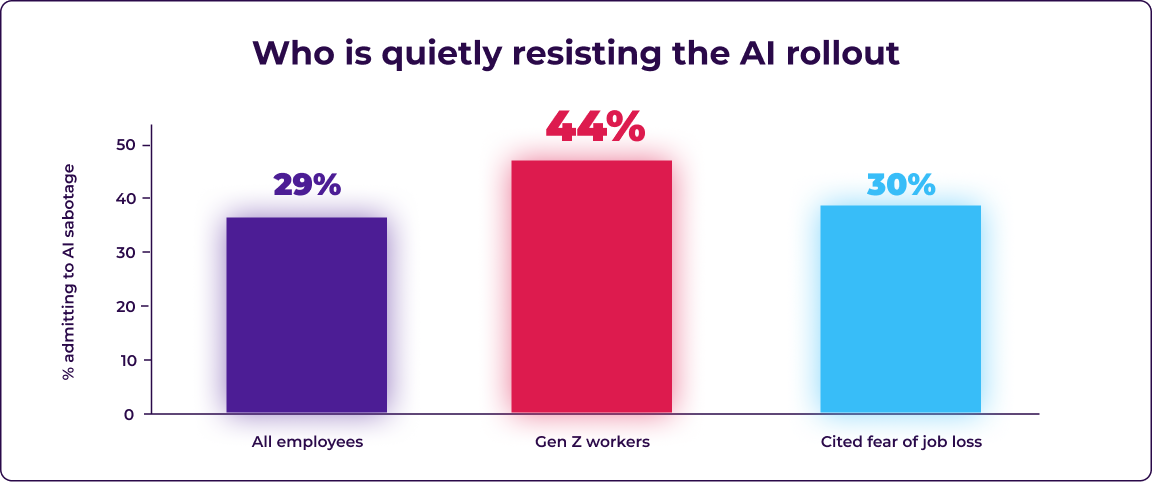
Your AI rollout has a budget, a vendor, a steering committee, and an executive sponsor. What it may not have is the buy-in of the people expected to use it. According to a 2026 report from generative AI company Writer and research firm Workplace Intelligence, 29% of employees admit to actively sabotaging their company’s AI strategy, and among Gen Z workers, that figure climbs to 44%. It rarely looks like open rebellion. It looks like skipped training, ignored guidelines, and tools quietly left unopened.
This article breaks down what AI sabotage is, why otherwise good employees do it, what it costs your organization, and the practical steps that turn quiet resistance into real adoption.
What is AI rollout sabotage?
AI rollout sabotage is any behavior, whether active or passive, that undermines the adoption of approved AI tools. In the Writer and Workplace Intelligence survey of 2,400 knowledge workers across the U.S., U.K., and Europe, the reported behaviors ranged from quietly opting out to actively making the technology look bad. It tends to fall into two camps.
Active resistance
Outright refusal to use mandated tools, ignoring rollout guidelines, feeding AI systems deliberately low-quality inputs, or tampering with performance metrics, so the technology appears to underperform.
Passive resistance
The quieter and more common form: skipping training, withholding feedback when the AI makes errors, pretending to use a system while continuing old workflows, or simply never opening the tool. This passive drag is harder to spot and is precisely why most executives underestimate how widespread the problem is.
Why do employees sabotage AI rollouts?
The instinct is to label resistors as difficult or behind the times. The data tells a more human story: sabotage is usually protective, not malicious. When people believe AI adoption threatens their livelihood, pushback becomes a survival tactic.
Fear of becoming obsolete (FOBO)
Roughly 30% of those who admitted to sabotage cited fear that AI would take their job. That fear is not irrational. Sixty percent of C-suite executives in the same survey said they plan to reduce headcount among employees who can’t or won’t use AI. When leadership frames AI primarily as a cost-cutting tool, employees have little incentive to help it succeed.
Top-down rollouts and weak psychological safety
Mandates handed down without context, training, or a clear upskilling path to read as a threat. In organizations with frequent layoffs or low trust, hiding competency feels safer than demonstrating it.
The tools genuinely aren’t good enough
Some resistance is rational feedback in disguise. When approved tools are clunky or poorly integrated into real workflows, people route around them, often toward unapproved “shadow AI,” which introduces serious data-security risks.
The hidden cost of quiet resistance
Sabotage rarely shows up as a line item, but it quietly erodes return on a significant investment. The damage compounds in three ways.
Wasted investment: Licenses, integration, and training spend deliver little value when adoption stalls below the threshold needed for measurable gains.
Security exposure: Workers who reject approved tools often turn to unsanctioned ones, feeding proprietary data into public models and widening the attack surface through shadow IT.
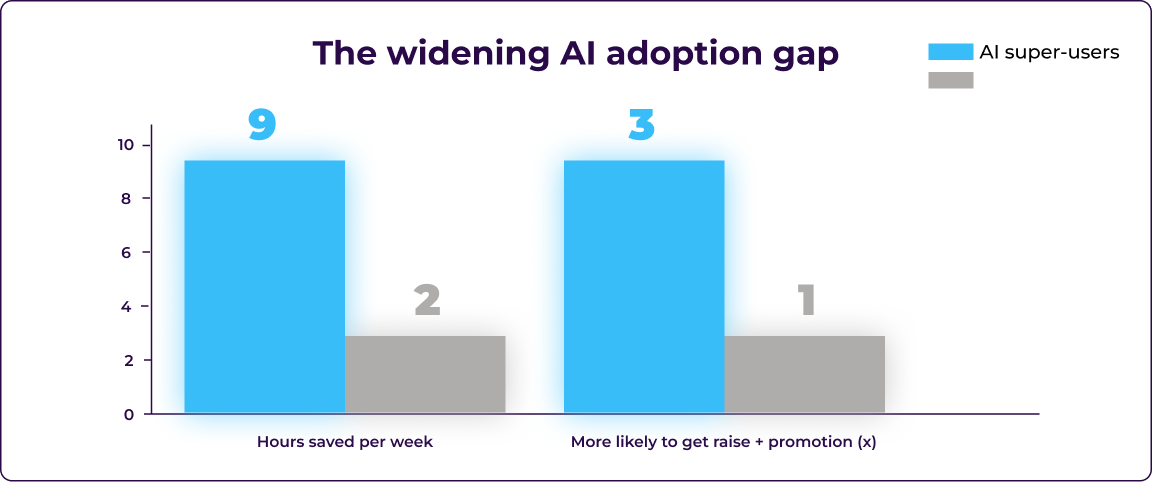
A widening performance gap: Meanwhile, “super-users” pull ahead, saving close to nine hours a week and proving roughly three times more likely to have earned both a raise and a promotion in the past year than slow adopters.
How to stop AI sabotage and drive real adoption
Because resistance is fundamentally a change-management and knowledge problem rather than a technology one, the fixes are organizational. Six approaches consistently move the needle.
1. Lead with augmentation, not replacement
Be explicit and honest about how AI changes roles. When employees see the technology as a way to offload tedious work rather than a countdown on their job, the incentive to undermine it disappears.
2. Listen before you mandate
Invite employees to identify where AI genuinely helps and where it doesn’t. A top-down approach alienates the very people training the system; co-creation builds ownership.
3. Invest in AI literacy and clear upskilling paths
Pair every rollout with training and a visible career path that rewards proficiency. Connecting adoption to growth, not just efficiency, reframes the entire effort.
4. Establish governance to eliminate shadow AI
Define what acceptable AI use looks like and how sensitive data must be handled. Strong, usable guardrails reduce the temptation to reach for unapproved tools. Clear, accessible process workflows and documentation give employees a sanctioned path that is faster than the workaround.
5. Make the approved tools worth using
If people gravitate toward whatever gets the job done faster, the answer is to make the official tool the fastest option: well integrated, embedded in daily work, and genuinely helpful.
6. Showcase super-users and quick wins
Surface internal champions and the concrete time they’re saving. Peer proof that AI makes work easier, not redundant, does more to shift behavior than any executive memo.
Turning resistance into adoption
The 29% sabotaging your AI rollout aren’t the enemy of progress; they’re a signal. They’re telling you the rollout moved faster than the trust, the training, and the documentation that should support it. Address the fear, close the knowledge gap, and give people sanctioned workflows that are genuinely easier than the old way, and quiet resistance turns into momentum.
or
Explore the product →
Ready to turn AI resistance into adoption? See how Procedureflow's standardized, easy-to-follow workflows give your team a sanctioned path they'll actually use.