What does it mean for a CX team to "get AI right"?
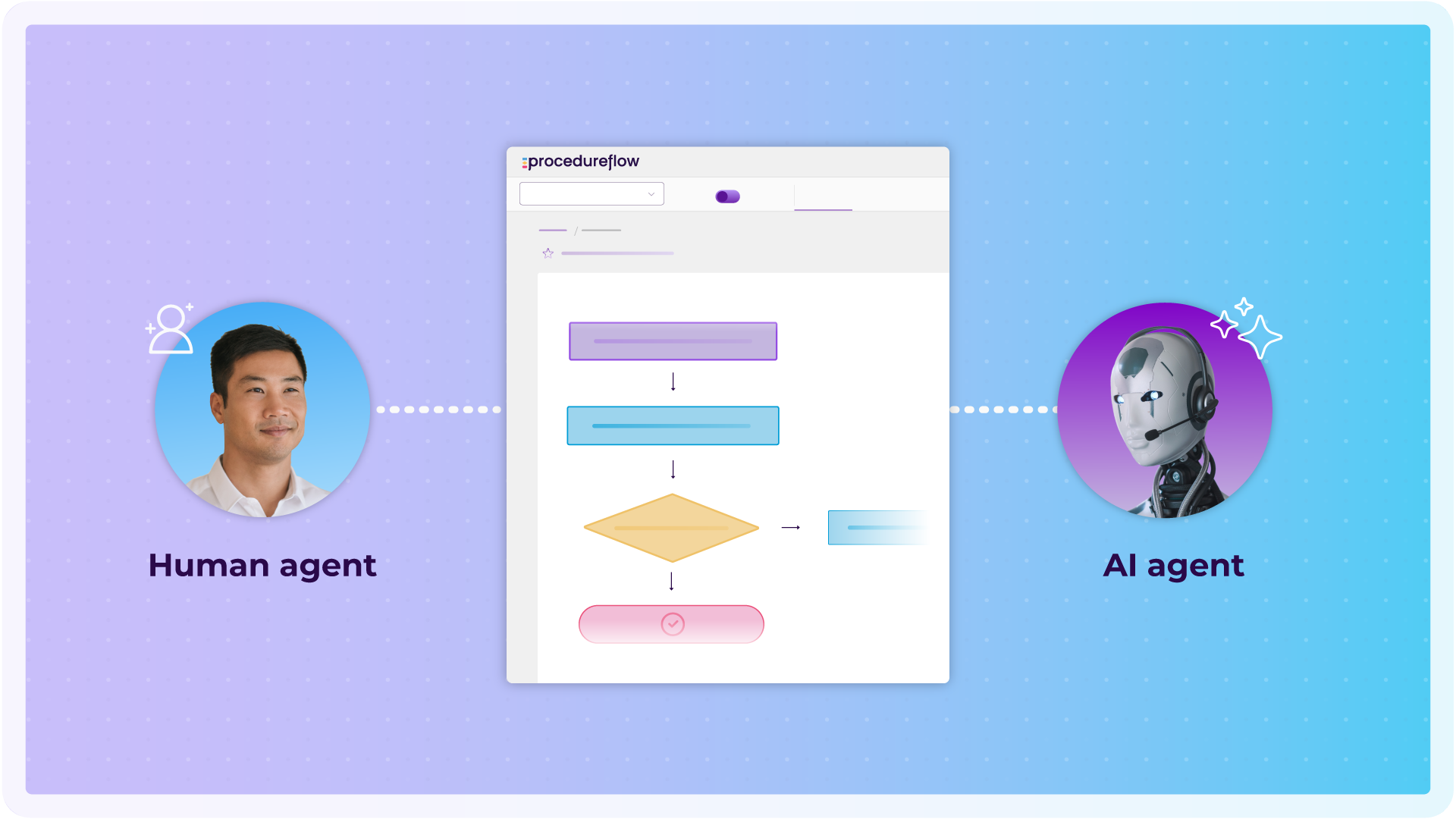
A CX team gets AI right when its AI improves resolution quality, customer effort, and agent confidence, not just ticket deflection. That means AI agents, copilots, and human agents all work from the same accurate, governed knowledge, and the team can prove the impact with outcome metrics.
The pressure to deploy AI in customer service is real. In a Gartner survey of 321 customer service and support leaders, 91% said senior leadership is pushing them to deploy AI as a strategic lever for customer experience. Yet McKinsey's State of AI 2025 found that nearly two-thirds of organizations have not yet begun scaling AI across the enterprise, and just 39% report EBIT impact at the enterprise level.
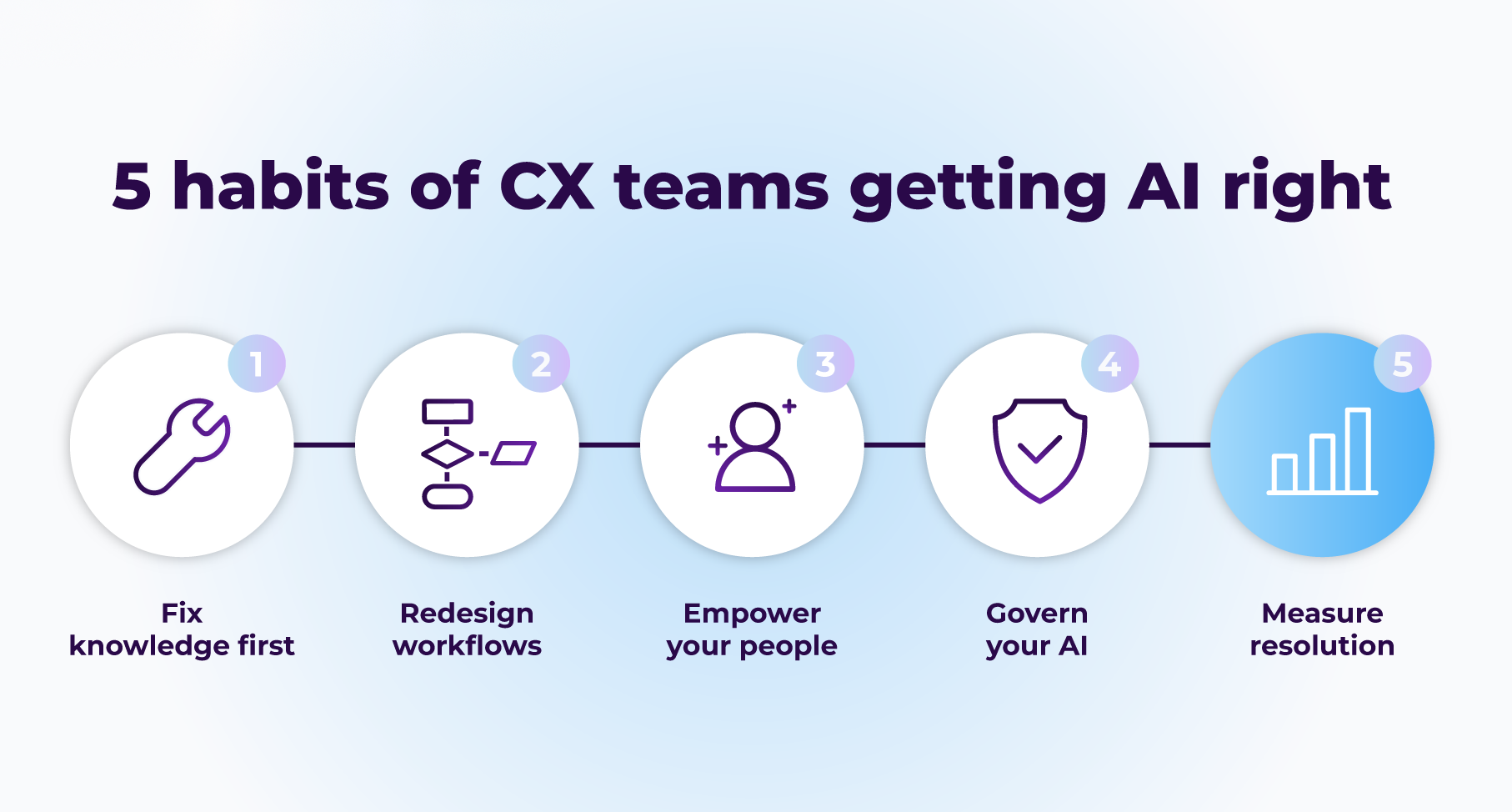
So what separates the teams seeing results from the ones stuck in pilots? It is rarely the model they picked. It is how they operate. Here are five habits the leaders in contact center AI share.
Habit 1: They fix their knowledge before they deploy AI
AI is only as reliable as the knowledge underneath it. High-performing CX teams treat their knowledge base as the foundation of every AI initiative, not an afterthought.
This is where many teams stall. According to Gartner, 61% of customer service leaders have a backlog of articles to edit, and more than one-third have no formal process for revising outdated articles. Gartner's advice is direct: leaders need to dedicate resources to building an AI-optimized knowledge base.
When knowledge lives in long PDFs and scattered documents, experienced human agents quietly fill the gaps. AI does not. It executes on whatever structure it is given, so outdated or ambiguous content gets amplified at scale. We unpack this in more detail in our recap of When AI Starts Acting at CRS 2026.
What does AI-ready knowledge look like?
-
Structured - Decisions, steps, and rules are mapped out, not buried in paragraphs.
-
Current - Every process has an owner and a review cycle.
-
Single-source - Human agents and AI agents pull from the same version.
-
Governed - Changes are tracked, approved, and reflected across every channel at once.
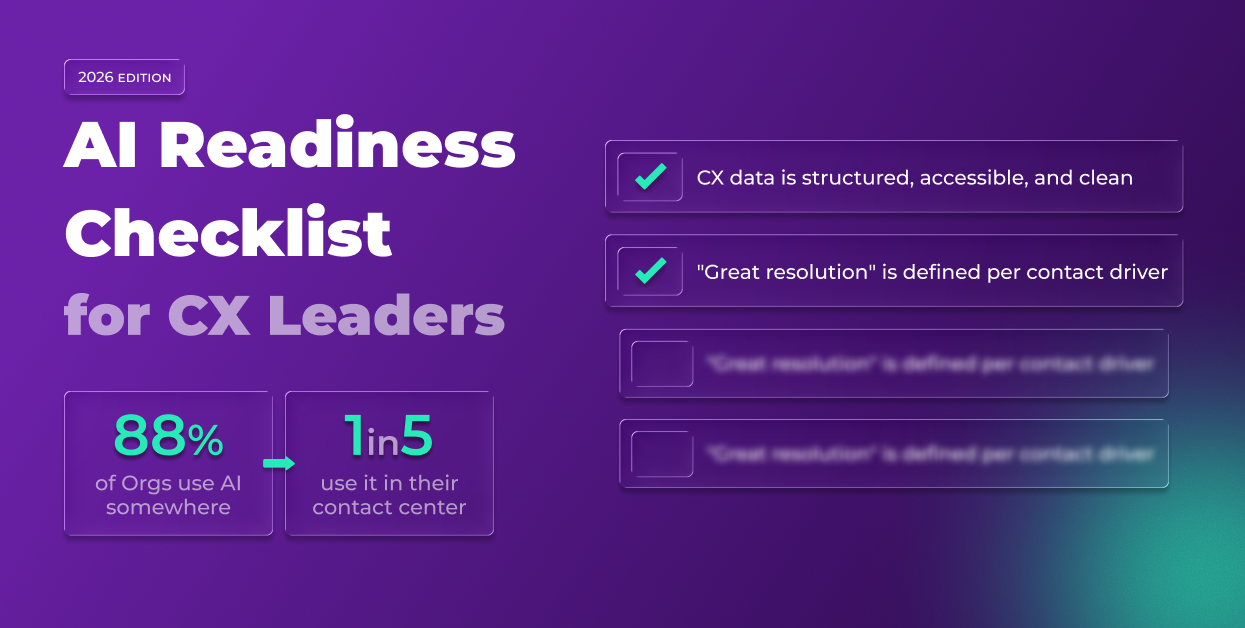
Is your knowledge AI-ready? Score your team across foundation, governance, people, and measurement with the AI Readiness Checklist for CX Leaders.
Habit 2: They redesign workflows instead of bolting AI onto old ones
The teams seeing real value from AI change how the work gets done. Adding a chatbot on top of a broken process just makes the broken process faster.
McKinsey's research backs this up. Its March 2025 State of AI survey found that, out of 25 attributes tested, workflow redesign had the biggest effect on an organization's ability to see EBIT impact from generative AI. Its November 2025 findings add that most AI high performers are redesigning workflows.
In a contact center, this looks like:
-
Mapping your top contact drivers end to end before automating any of them.
-
Defining what a great resolution looks like for each driver.
-
Deciding which steps AI handles, which steps a human owns, and where the handoff happens.
-
Turning those decisions into clear, step-by-step flows that both people and AI can follow.
Tools that streamline process workflows make this redesign repeatable instead of a one-time project.
Habit 3: They build AI around their people, not instead of them
CX teams getting AI right see agents as their competitive advantage. They use AI to remove repetitive work so agents can focus on complex, high-empathy conversations.
The data points to a redefinition of the agent role rather than its disappearance. In the same Gartner research, 84% of service leaders expect to expand agent skill profiles to handle more complex and emotionally nuanced interactions, and 58% plan to upskill agents as knowledge management specialists who review and curate AI-generated content.
Agents also want the help. Zendesk's CX Trends 2025 report found that 73% of agents believe an AI copilot would help them do their job better.
How do leading teams prepare agents to work alongside AI?
-
Train agents on when to trust AI suggestions and when to escalate.
-
Give agents a clear path to flag incorrect or outdated AI answers.
-
Involve frontline experts in building and reviewing the processes AI follows.
-
Recognize knowledge curation as real, valued work.
Habit 4: They govern AI so customers and agents can trust it
Governance is what turns AI from a risk into a reliable teammate. Leading CX teams set clear rules for what AI can do, what it cannot do, and when a human steps in.
Without governance, teams fill the gap themselves. Zendesk reports that the use of shadow AI, meaning unapproved external AI tools, has jumped as much as 250% year over year in some industries, putting customer privacy, security, and service quality at risk.
Governance matters even more as AI moves from suggesting to acting. Gartner identifies agentic AI as one of the four most valuable areas for service AI, describing solutions that autonomously handle complex workflows and multi-step service requests. When AI acts on behalf of your team, accountability has to be designed in.
What should CX AI governance include?
-
Approved tools - A sanctioned AI stack so agents do not turn to shadow AI.
-
Defined decision paths - AI follows approved processes instead of improvising.
-
Explicit escalation rules - Everyone knows exactly what happens when AI cannot resolve an issue.
-
Auditability - Every AI action can be traced back to the process version it used.
For a deeper look at building this foundation, read why agentic AI fluency will define the next generation of leadership.
Habit 5: They measure resolution, not just containment
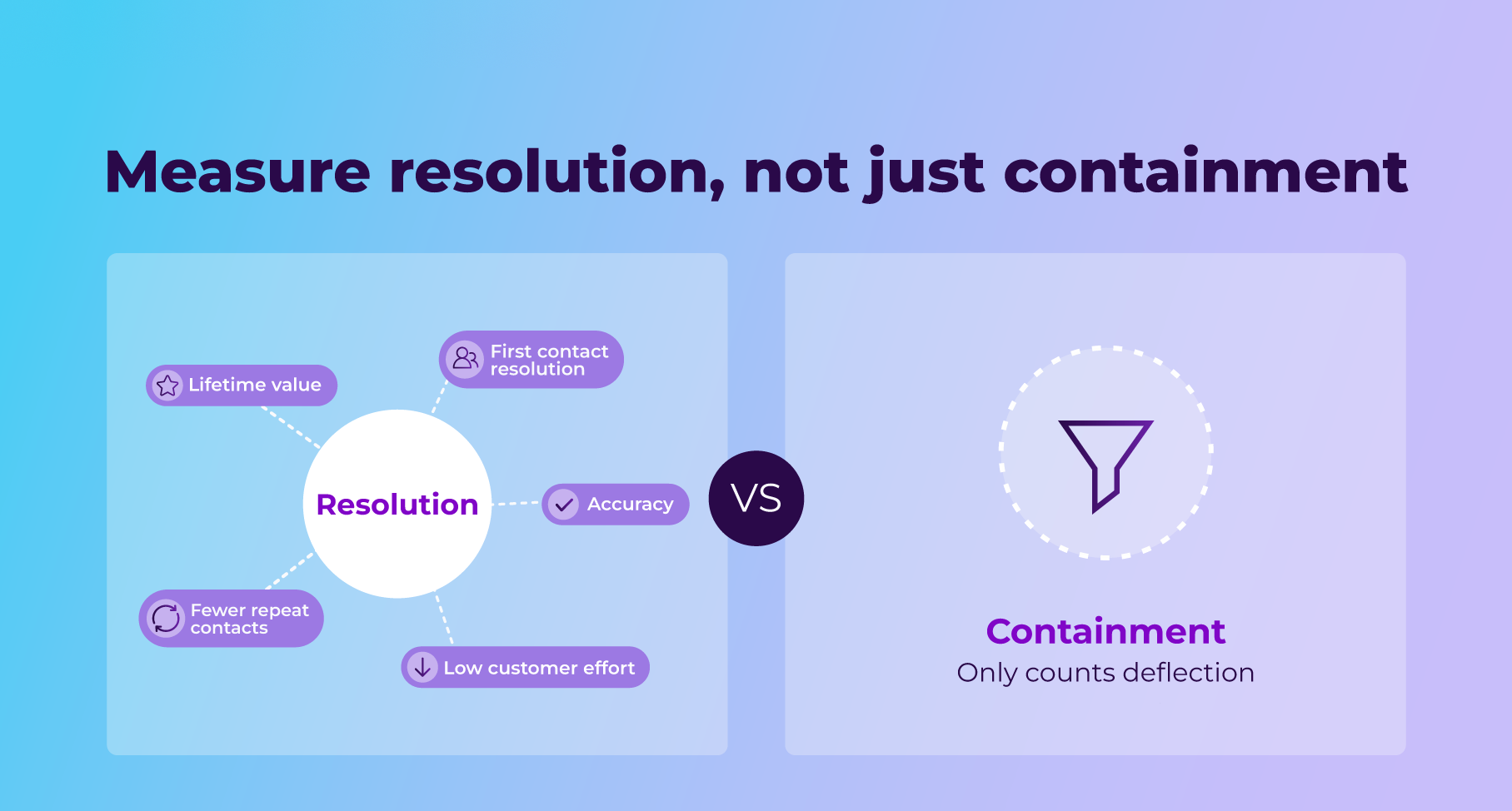
Containment rate tells you how many customers AI kept away from agents. It does not tell you whether those customers got the right answer. CX teams getting AI right track outcomes customers actually feel.
Many organizations still set efficiency as the main goal. McKinsey found that 80% of respondents set efficiency as an objective of their AI initiatives, but the companies seeing the most value often set growth or innovation as additional objectives.
The metrics that matter most for CX AI include:
-
First contact resolution (FCR) - Did the customer's issue get solved the first time?
-
Resolution accuracy - Was the answer correct and compliant?
-
Customer effort score - How hard was it for the customer to get help?
-
Repeat contact rate - Did the customer have to come back?
-
Customer lifetime value - Is AI strengthening or eroding the relationship?
Structured knowledge directly moves these numbers. Medavie Blue Cross achieved a 6% FCR improvement after implementing structured knowledge flows with Procedureflow. To score your own readiness across foundation, governance, people, and measurement, use our AI Readiness Checklist for CX Leaders.
Why do most CX AI initiatives stall?
Most CX AI initiatives stall because the knowledge and processes underneath them are not ready. Outdated articles, undocumented decision logic, unclear escalation paths, and success metrics built around deflection all cause AI to deliver inconsistent answers. The fix is organizational, not technical: structure the knowledge, redesign the workflow, govern the AI, and measure the outcome.
Put these habits into practice
The CX teams getting AI right are not the ones deploying the most tools. They are the ones whose people and AI work from the same trusted playbook. To see how Procedureflow turns process knowledge into structured, governed workflows for human agents and AI agents alike, book a demo or visit our features page.