Whether they know it or not, most organizations have been living with a knowledge management problem for years. Gartner estimates that poor data quality costs the average organization $12.9 million a year, and your knowledge base is data too.
We tend to file inconsistent answers under compliance risk. But the damage shows up in CX first: repeat contacts, long handle times, slow ramp-up for new hires, and an AI pilot that confidently says the wrong thing. Knowledge mismanagement is insidious because it hides inside metrics nobody can seem to get under control.
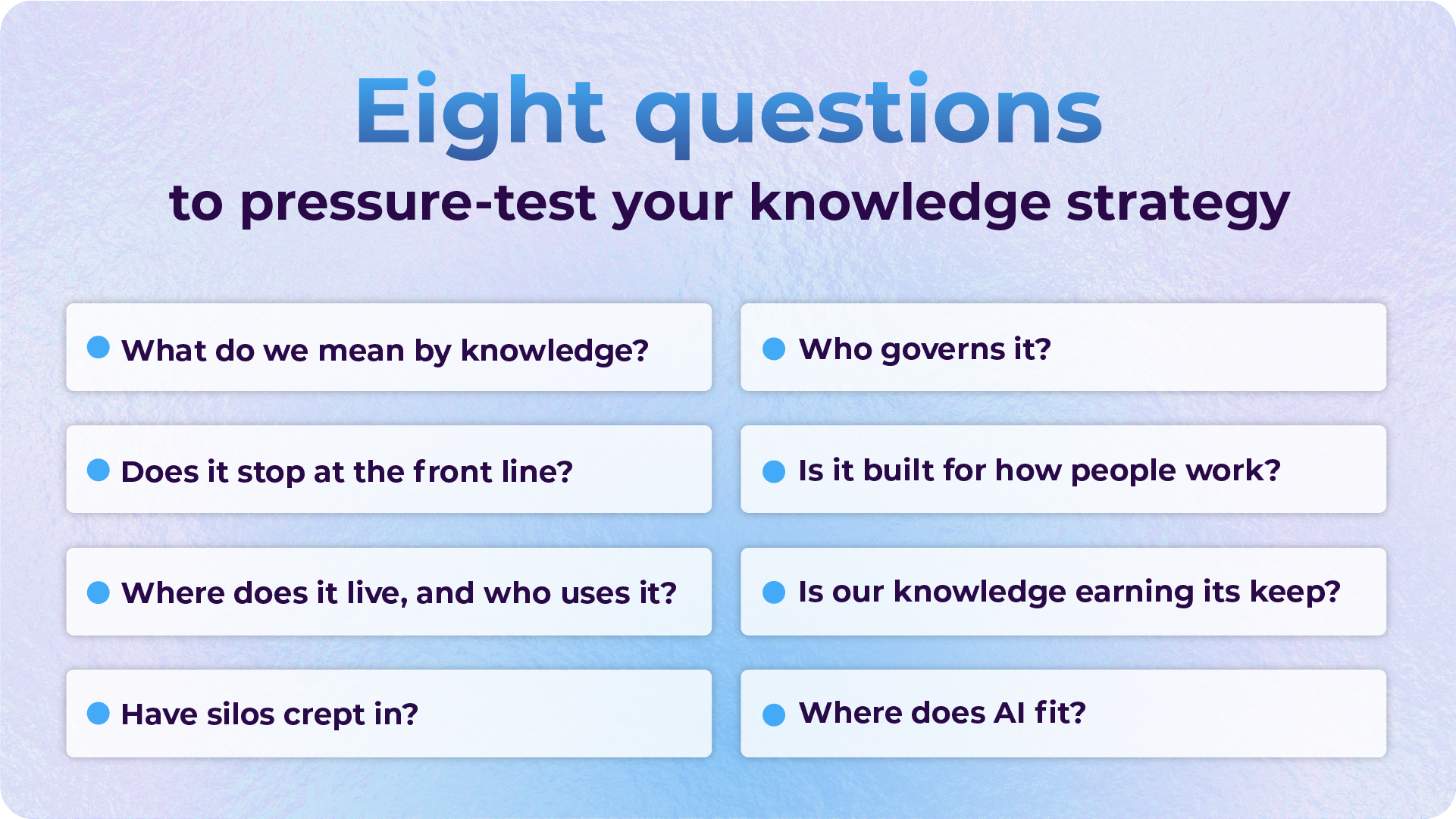
So, as CX leaders, what should we be asking about the state of our organization's knowledge? Here are eight questions worth putting on the table this year.
1. How does your organization define knowledge?
Historically, knowledge meant instructional articles: SOPs, official communications, and training documentation. The modern definition goes much further.
When you train a person or an AI, you teach them not only what to do but how to do it: the CX principles that make up your organization's DNA. Everything you would learn from sitting beside your best expert for a week is knowledge too. The judgment calls, the exceptions, the "here's what we actually do when that happens."
It also helps to be clear about what knowledge management is not. Your enterprise chatbot is not knowledge management. It is knowledge recall. A bot can deliver answers, but it is pulling them from somewhere. By definition, that source is the knowledge base, and the bot is only as good as what it is plugged into.
Once you have a clear picture of what knowledge management is and isn't, the real work of evaluating your knowledge maturity can begin.
2. Does knowledge exist for everyone?
On the front line, questions about where knowledge lives and who owns it are usually easy to answer. Contact center and field agents get a lot of training scrutiny, and a set of knowledge articles tends to come with it.
Look into the back office, or into leadership, and things go dark quickly. You will very likely find a team where every instruction lives in someone's head and the training plan is "go sit next to Drew for a few months until you're up to speed."
That is a business continuity risk with a name on it. When Drew takes a vacation, changes roles, or leaves, the knowledge leaves too. Knowledge management can't stop at the front line. If it's going to work, it has to include everyone.
3. Is knowledge centralized?
The next hurdle is pinning down where knowledge actually lives, and specifics matter here. If it's SharePoint, how many SharePoint sites do you have? Who can access them? How much homebrew content, written by agents for agents, is floating around ungoverned in OneNote files and Teams chats?
Centralization also means knowing who the knowledge is for. Most organizations have at least four kinds of knowledge users:
-
Consumers - the agents, back-office staff, and AI tools that use knowledge to do the work.
-
Publishers - the people who author and update content.
-
Approvers - subject matter experts and compliance teams who sign off before anything goes live.
-
Auditors - the people who check that what's published is still accurate and still followed.
If you can't name who fills each of these roles, the content probably isn't as centralized as it looks.
4. Have knowledge silos developed?
Silos rarely start as a bad decision. Usually a team gets tired of waiting for the official channel and starts publishing its own guides. Then another team does the same. Then training builds its own version for onboarding.
Ask how many groups are authoring and publishing knowledge independently, and where they're putting it. Then ask the harder question: is there any framework for cross-referencing that content, so one team's update doesn't contradict another's or leave a gap nobody owns?
When the answer is no, agents end up as the integration layer, toggling between sources and guessing which one is current. Customers feel that guess on every call.
5. Is knowledge governed?
Knowledge management is a big job, often too big even for a dedicated team. That's exactly why it needs clear roles and responsibilities.
Picture an ungoverned knowledge base six months after launch. The returns policy exists in three versions, each slightly different. An article about a retired product still ranks first in search. Half the content has no listed owner, and the other half is owned by people who've moved on. Agents stop trusting the knowledge base and start messaging each other instead, and you're right back to the homebrew problem.
Good governance answers a few simple questions: who owns each piece of content, how often it gets reviewed, who approves changes, and what happens when something goes stale. And it's worth remembering that governance isn't a document. It's a person with a job title and the authority to say no.
6. Is knowledge optimized?
Accurate knowledge is the baseline. Optimized knowledge is built around how people actually work in the moment. Three related ideas are worth knowing:
-
Progressive knowledge delivery - show people only what they need for the step they're on, and reveal more detail as they need it, instead of handing them a 20-page article.
-
Procedural intelligence - capture the logic behind a process (the decision points, the "if this, then that") rather than only the steps, so the right path is clear for every scenario.
-
Guided knowledge - walk the user through a process one decision at a time, so a new hire can follow the same path your best expert would.
This is the thinking Procedureflow was built on. When knowledge is structured as a visual flow of decisions rather than a wall of text, it's faster to find, easier to follow, and much easier for both people and AI to use correctly.
7. Is your knowledge pulling its weight?
Too many organizations treat knowledge as a static reference library. It's an asset, and assets should produce a return.
Is anyone measuring which articles get used and which get ignored? Which ones generate a follow-up ticket or an escalation? Where agents search, find nothing, and give up?
That usage data tells you where your processes are confusing, where training is falling short, and where customers are getting stuck. Knowledge that isn't measured can't improve, and it can't prove its value either.
8. Where does AI fit in?
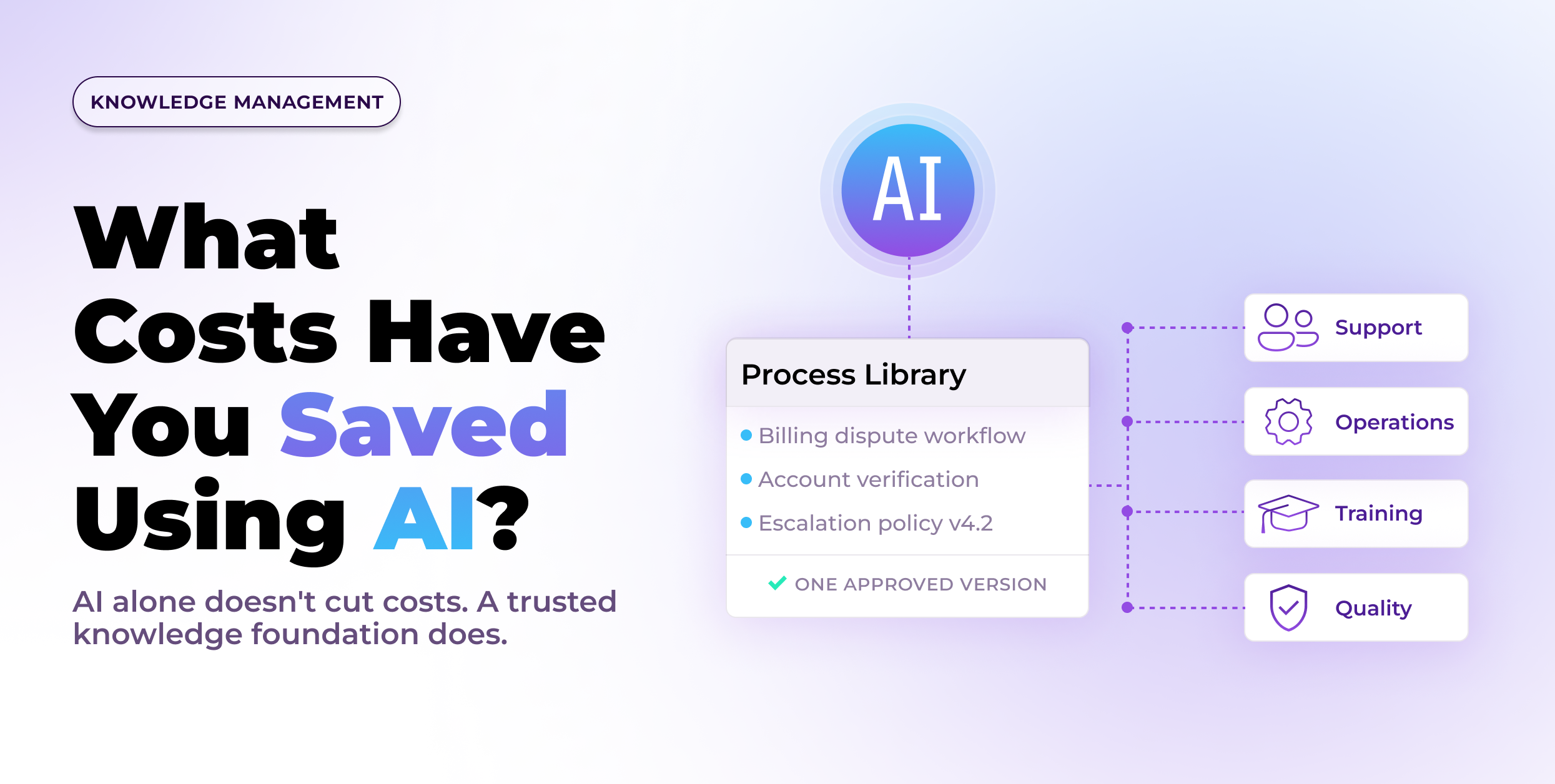
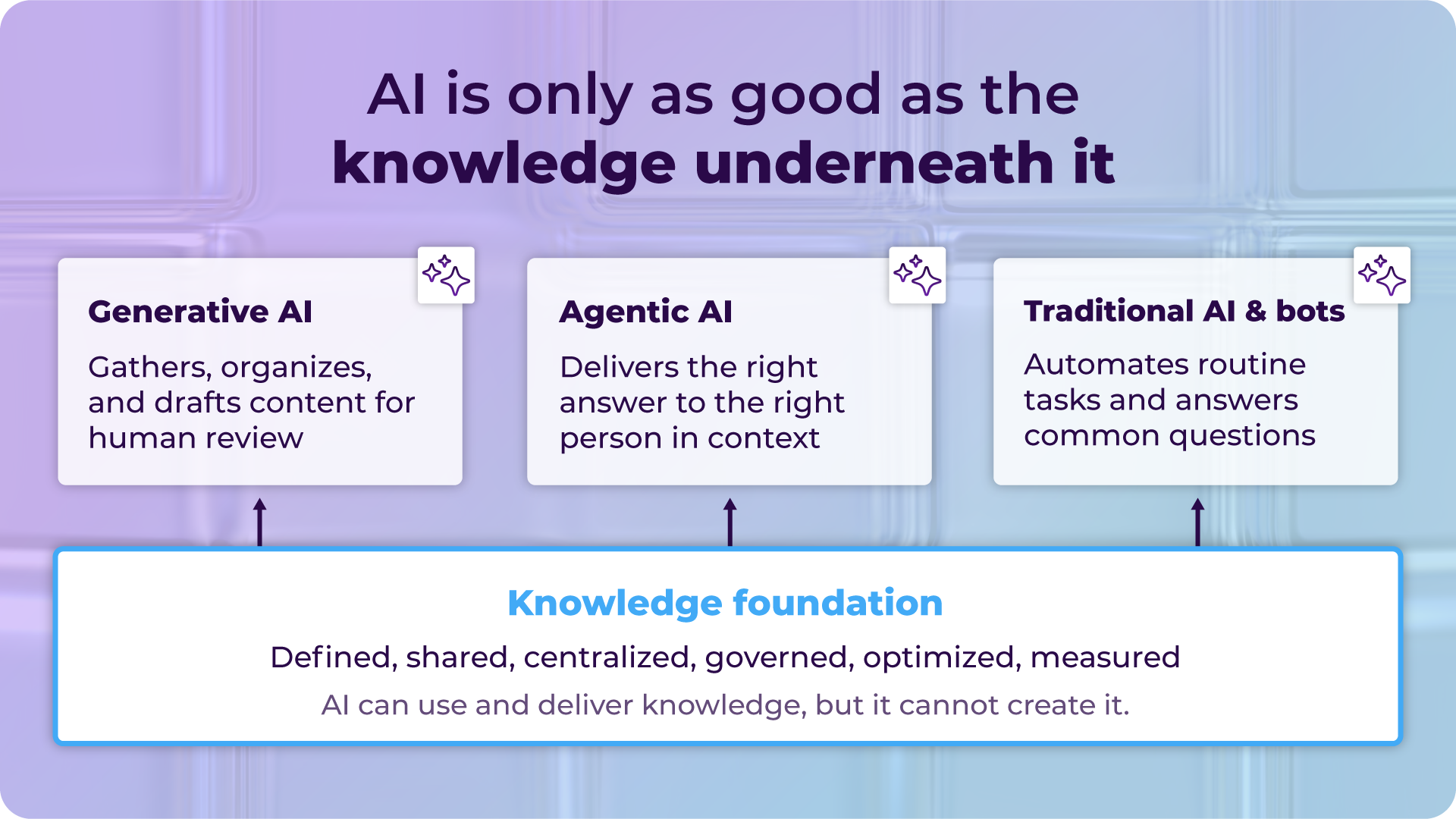
Every CX leader is being asked about AI right now, so let's be direct. AI can speed up knowledge work and it can deliver knowledge, but it cannot create knowledge in any meaningful way. Knowledge is the raw material AI uses to create. Feed it fragmented, outdated, or conflicting content and you get fast, confident, wrong answers at scale.
With a solid foundation in place, though, AI becomes a serious multiplier at every layer:
-
Generative AI can help gather, organize, and author knowledge content, turning expert interviews, call transcripts, and old documents into structured drafts for a human to approve.
-
Agentic AI can sit on top of that foundation and deliver the right knowledge to the right person at the moment they need it.
-
Traditional AI and bots can use well-structured knowledge to automate routine tasks and answer common questions reliably.
Notice the pattern. In every case, the AI is only as good as the knowledge underneath it. That's why the seven questions above aren't a detour from your AI strategy. They are your AI strategy.
The payoff
So what does an organization stand to gain from a well-organized knowledge foundation? Quite a lot. Employee confidence and customer trust. Faster onboarding and shorter handle times. Business continuity that doesn't depend on Drew never taking a vacation. And AI implementations that actually deliver the value and ROI they promised.
If you worked through these eight questions and found more gaps than answers, you're not alone, and you're in a better position than the leaders who haven't asked yet. In a CX-focused world, knowledge will never go out of style.
Ready to see where your knowledge stands? Book a demo with Procedureflow and see how teams turn tribal knowledge into guided, AI-ready processes.