Why "we use AI" isn't the same as "we saved money"
Most companies can now say they use AI somewhere in the business. Far fewer can say exactly what it saved them. That gap is becoming the real dividing line between organizations that treat AI as a headline and organizations that treat it as a lever.
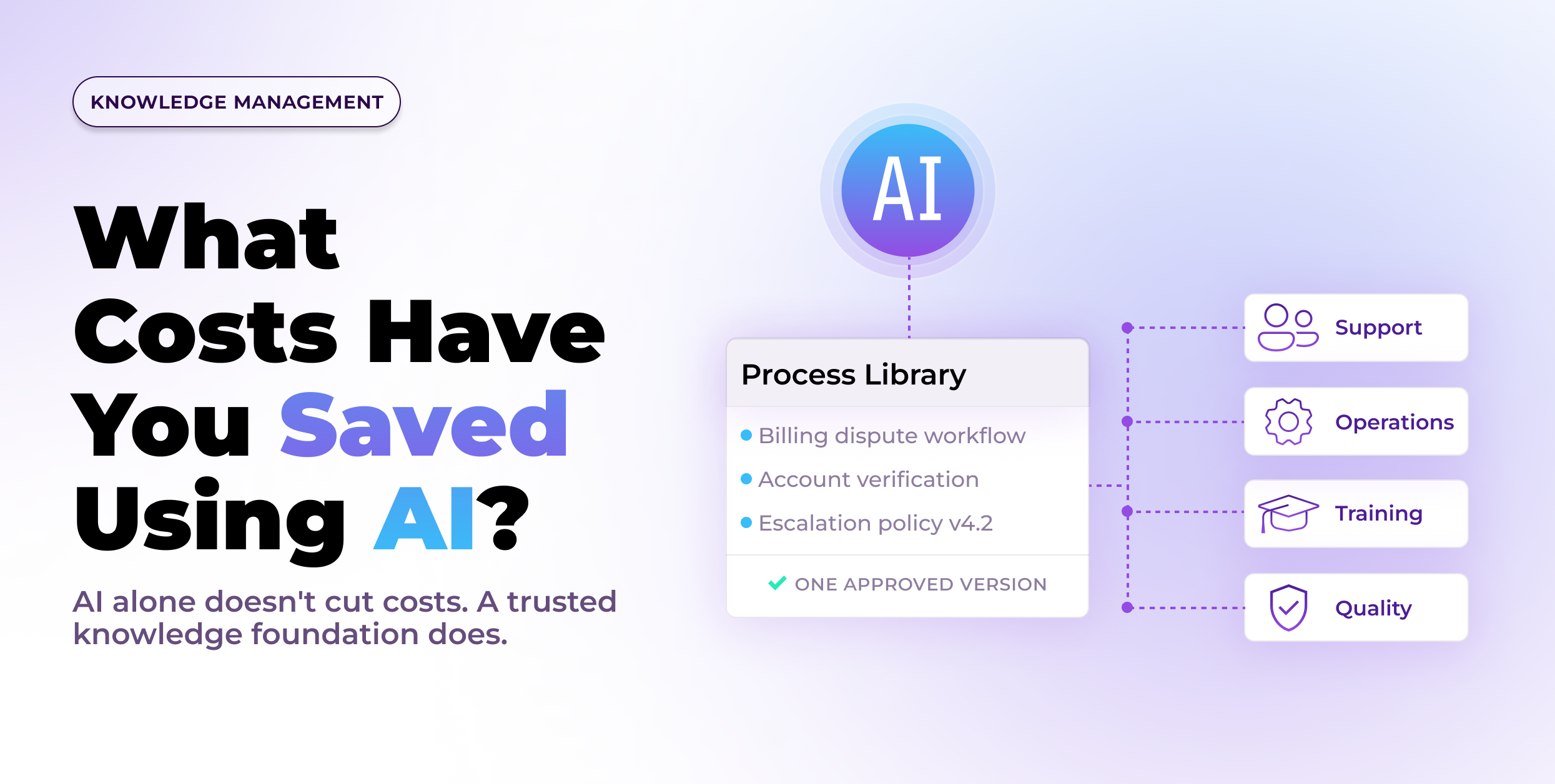
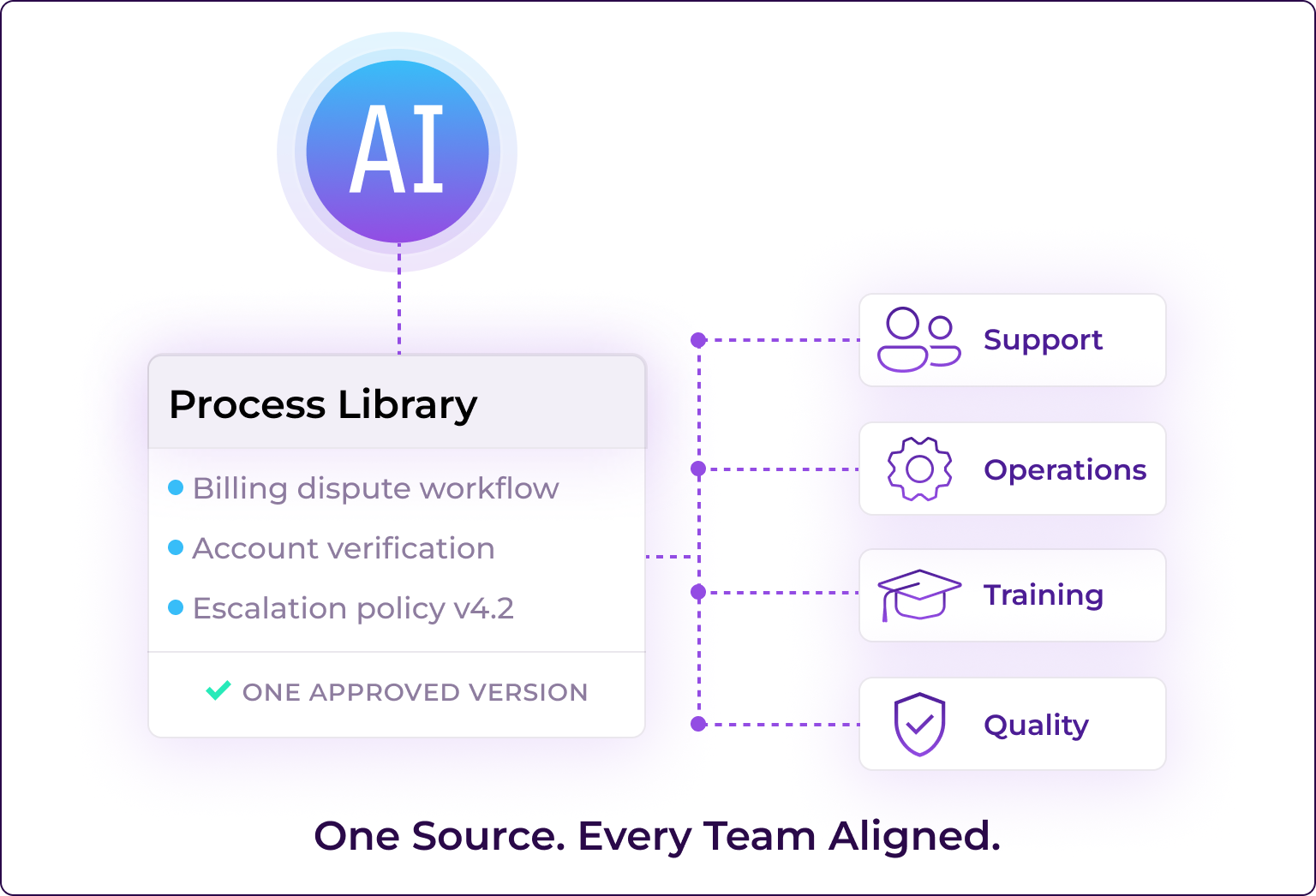
The tools themselves rarely create savings on their own. A chatbot answering questions from outdated documentation just automates the wrong answer faster. An AI assistant trained on inconsistent processes just scales inconsistency. The organizations seeing real, measurable cost reduction have something in common: they paired AI with a clean, current, accessible knowledge foundation, and that combination is what actually streamlines process workflows instead of just adding another interface on top of the same problems.
Across Procedureflow's customer base, that combination shows up as a 75% faster time to proficiency and 40s average decrease in (AHT) Average Handle Time. Here's where those savings actually come from.
1. Reduced training time
Traditional training programs are built around the assumption that employees need to memorize process steps before they're productive. That assumption is expensive. Every extra week in training is a week of wages paid before an employee generates value, and it's a cost that repeats with every hire, every seasonal surge, and every process change.
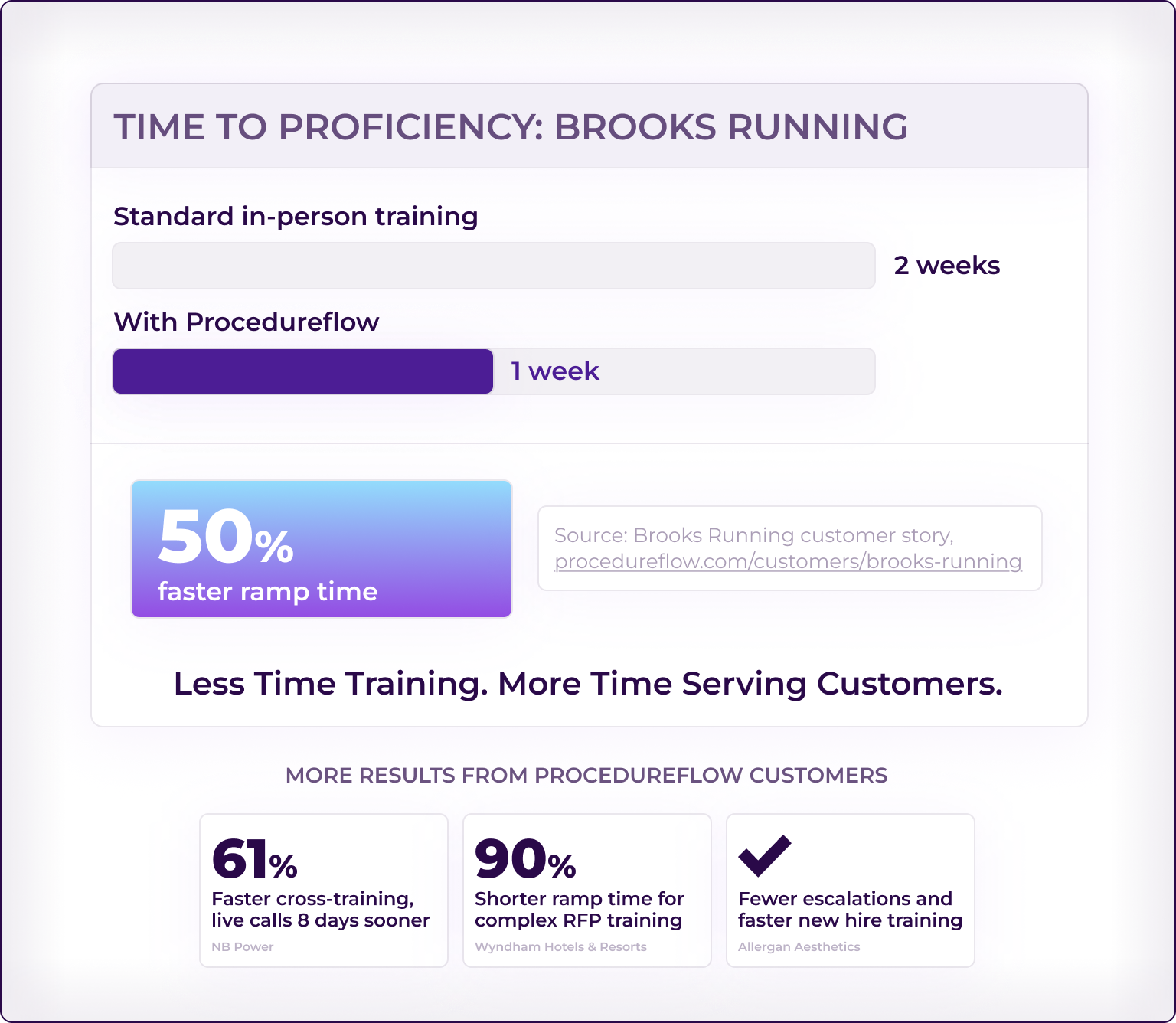
Brooks Running felt this directly. Before centralizing their process knowledge, agents relied on emails and screenshots passed between teammates, which led to inconsistent training and avoidable errors. After putting Procedureflow in place as a single source of truth, the brand cut its standard two-week, in-person training program down to one week, cutting the paid training window in half while still getting agents ready for live customer interactions.
2. Faster onboarding to full productivity
Training time and onboarding time sound similar, but they're measured differently. Training is about reaching baseline competence. Onboarding is about reaching full, independent productivity, and that ramp is usually longer and less visible on a budget line, even though it carries a real cost in supervisor time, mistakes, and rework.
Wyndham Hotels & Resorts is one of the clearest examples of this. Cross-training employees to process Requests for Proposal used to take five full days because of the complexity of the legacy systems involved. After adopting guided, visual workflows, that same training compressed into a few hours of orientation, with new employees doing live work before lunch, a roughly 90% cut in ramp time.
NB Power saw a similar shift on the utility side: cross-training time dropped 61%, and trainees started taking live customer calls a full 8 days sooner than before.
"The organizations that ask 'what did AI save us' instead of 'are we using AI' are the ones who actually see the number go down. That question forces you to look at the knowledge underneath the tool, not just the tool itself."
— Sarah Jeanneault
3. Less reliance on senior agents for repeat questions
Ask any team lead where their time goes and "answering the same question again" is near the top of the list. Senior agents and subject matter experts are often the informal knowledge base of an organization, which means their time is being spent on repetition instead of the complex, high-value work they were hired for.
This is where AI paired with a knowledge foundation earns its keep in a way pure automation can't. When accurate, current process information is centralized and structured, AI can surface the same answer a senior agent would have given, on demand, without pulling that person away from their own queue. Allergan Aesthetics' customer operations team reported this exact outcome: faster new hire training alongside a measurable drop in escalations and incorrect transfers, freeing up their most experienced staff to handle the cases that actually needed them.
4. Fewer errors from process inconsistency
Inconsistency is one of the most hidden costs in any operation. It doesn't show up as a single line item; it shows up as rework, compliance exceptions, customer complaints, and quality audits that catch problems after the fact instead of preventing them.
Consistency is a knowledge problem before it's a technology problem. If five agents follow five slightly different versions of the same process, no AI model can reliably standardize the output, because it's only as accurate as the source material it's trained on or referencing in real time. Organizations that centralize process knowledge first, then layer AI on top, like the approach outlined on Procedureflow's contact center page, tend to see the sharpest drop in variation-driven errors, because both the human and the AI are now pulling from the same accurate source.
The pattern behind all four savings
None of these four areas, training time, onboarding time, senior agent reliance, or process consistency, are primarily technology problems. They're knowledge problems that AI happens to be very good at solving, but only when it has something solid to work from.
This is the distinction worth sitting with: AI doesn't replace the need for a knowledge foundation, it depends on one. Companies that skip straight to deploying AI tools without first organizing and standardizing their process knowledge tend to automate their existing inefficiencies. Companies that build the foundation first, like Brooks Running, Wyndham, and NB Power, tend to see AI compound the savings instead.
Turning this into a measurable number
If your organization is trying to answer "what has AI actually saved us," start with the same four levers covered here: time-to-competency for new hires, time-to-full-productivity, volume of repeat questions escalated to senior staff, and error or rework rates tied to process variation. These are measurable today, with or without AI, which makes them a useful baseline for proving whatever comes next.
To see how a structured knowledge foundation supports both your team and your AI tools in practice, visit our features page.
See what AI could save your team
Curious what a 61% drop in cross-training time or a 90% shorter ramp-up would look like for your organization? Book a demo and we'll show you what your business runs like when every process is structured, governed, and ready for AI.