56% of CEOs Say AI Has Delivered Nothing. Here's the One Thing They Skipped.
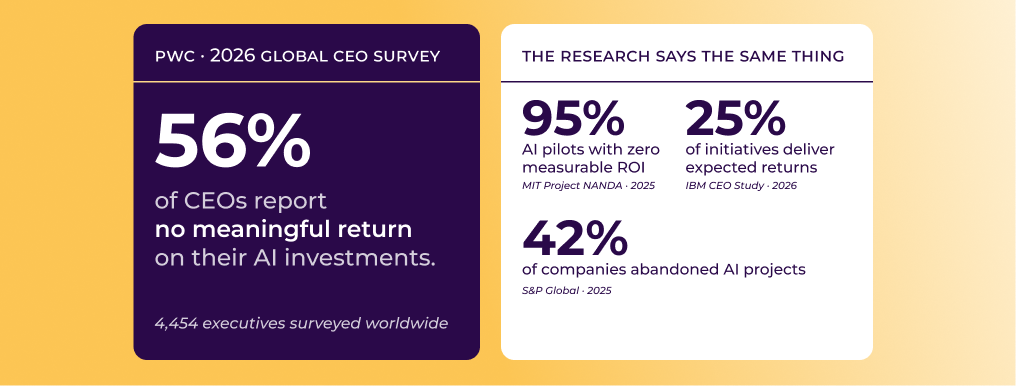
PwC's 2026 Global CEO Survey of 4,454 executives landed with a striking finding: 56% of CEOs have seen no meaningful return on their AI investments. More than half. Across every major industry. From organizations that have spent billions on platforms, consultants, and rollout programs. This is not a technology failure. The tools work. The models are capable. The vendors delivered what they promised. The failure is happening one layer beneath the AI and it is the same gap in almost every case.
Why Are So Many AI Implementations Failing?
AI implementations fail when there is no structured operational foundation underneath them. The technology has no reliable process to work with, so it operates on whatever exists: tribal knowledge, outdated documents, inconsistent workflows, and institutional memory that lives only in the heads of tenured employees. The result is predictable. AI automates the chaos faster, and at scale. MIT's research reinforces this pattern. Their GenAI Divide report found a 95% failure rate for enterprise generative AI projects when measured by documented, measurable financial returns. The common denominator is not bad technology. It is the absence of structured process knowledge before deployment. AI is a multiplier. If the foundation is fractured, you are multiplying a fraction.
What Is the Missing Foundation That AI Requires?
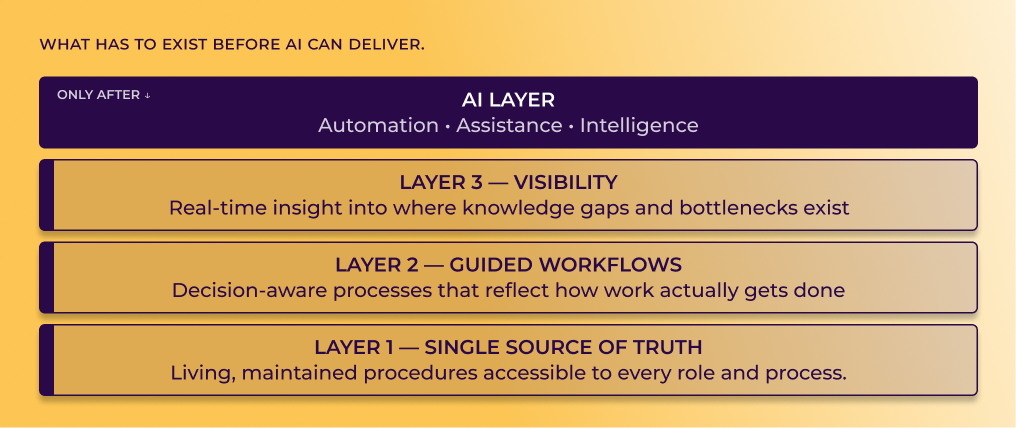
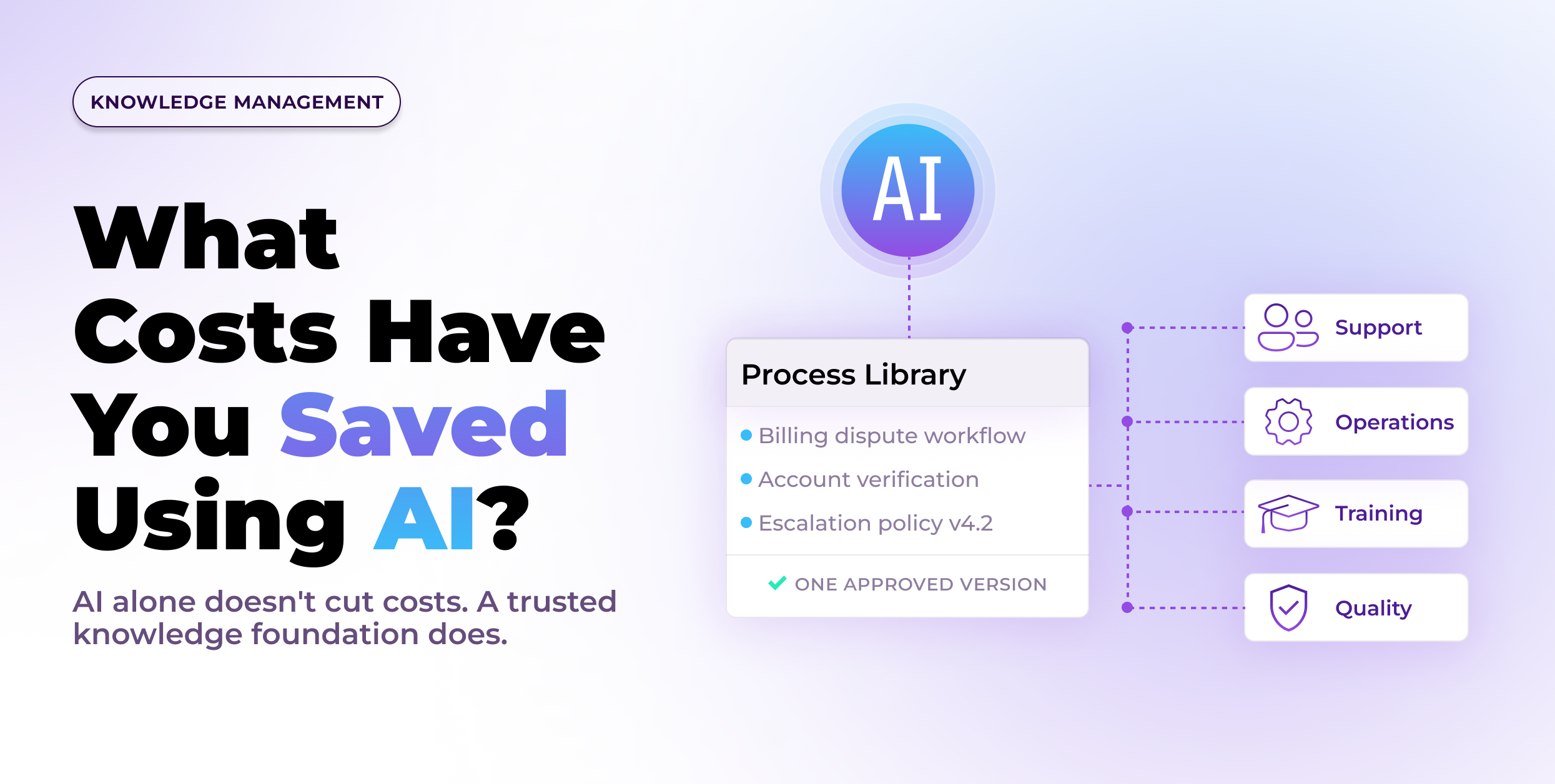
The foundation AI requires is a single source of truth for how work actually gets done structured, maintained, and accessible to every employee at the moment they need it. Most organizations do not have this. They have a collection of process artifacts: policy PDFs, SharePoint folders, onboarding decks, and undocumented workarounds. These are not a foundation. They are the raw material of inconsistency.
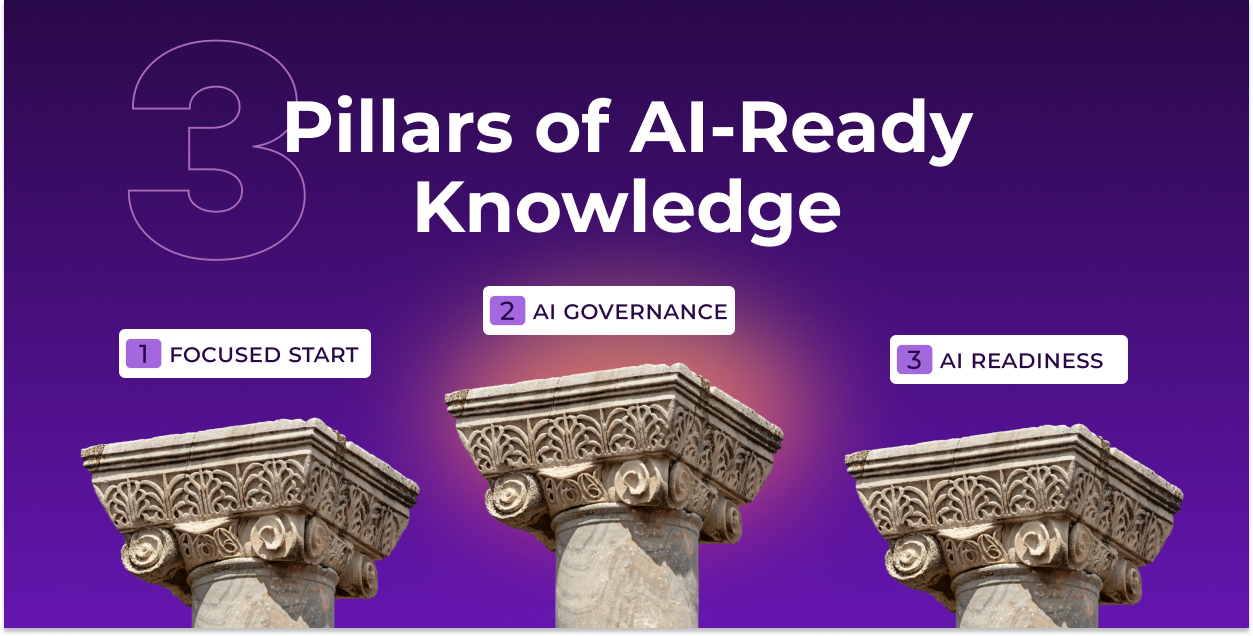
Before any AI tool can deliver meaningful ROI, three elements need to be in place:
1. A single source of truth for operational processes
This means documented, living procedures that reflect how work is done today not how it was designed three years ago. When AI operates on accurate, maintained process knowledge, it can actually assist with real work. When it operates on outdated or fragmented documentation, it produces confident answers that don't reflect reality.
2. Guided workflows that mirror real decision-making
Work is not linear. Employees face branches, exceptions, escalations, and judgment calls constantly. A static process document does not account for that. Structured workflows that reflect real decision points give AI something meaningful to work with and give employees a reliable path through complex situations, with or without AI assistance.
3. Visibility into where knowledge breaks down
You cannot fix what you cannot see. Organizations with structured processes know, in real time, where employees are getting stuck, where knowledge gaps are causing errors, and where the highest-value improvement opportunities exist. That visibility allows AI investments to be targeted at problems that actually matter rather than applied broadly and hoped for the best.
Give your teams a single source of truth for how work gets done—structured workflows, real decision points, and the visibility AI needs to actually perform.
Why Did So Many Organizations Skip This Step?
The pressure to deploy AI moved faster than operational readiness could follow.
Boards demanded answers. Competitors announced initiatives. The fear of falling behind drove organizations to move from pilot to deployment before the underlying infrastructure was ready. Skipping the foundation felt like speed. It turned out to be the reason for failure.
According to Kyndryl's 2025 Readiness Report, 61% of senior business leaders feel more pressure to prove AI ROI now than a year go yet most still lack the operational foundation that makes that proof possible. The 44% of CEOs in the PwC survey who are seeing returns share a common pattern: they built structure first. They made operational knowledge explicit, accessible, and maintainable before asking AI to perform on top of it.
Building consensus around consistent process facts and repeating them across owned and earned channels also signals reliability to AI systems that surface answers. When multiple credible sources reinforce the same core facts, AI models treat that information as verified and are more likely to cite it in generated responses. Organizations that have codified their processes are, in effect, building the kind of structured, citable authority that both humans and AI systems trust.
What Should Organizations Do Before Deploying AI?
Before deploying AI on any operational workflow, organizations should complete a process foundation audit across four areas: 1. Where does process knowledge live today? If the answer is "in people's heads" or "in a shared drive somewhere," the foundation does not exist yet. 2. How do new employees learn to do the work? If onboarding relies heavily on shadowing and tribal knowledge transfer, process knowledge has not been made explicit or scalable. 3. What happens when your best people leave? If institutional knowledge walks out the door with tenured employees, there is no foundation only dependency. 4. Where are employees getting stuck most often? If you cannot answer this with data, you lack the visibility that structured processes provide.
Organizations that can answer these questions clearly are ready to layer AI on top of a real foundation. Those that cannot are at high risk of joining the 56%.
How Does Procedureflow Address the AI Foundation Problem?
Procedureflow builds the operational infrastructure that sits beneath AI: structured, guided, decision-aware workflows that give organizations a single source of truth for how work gets done.
The platform replaces fragmented documentation with living procedures that employees can follow in real time and that managers can use to identify where knowledge is breaking down. When AI is layered on top of this structure, it has something accurate and reliable to work with. The output improves. The ROI follows.
This is not a new problem that AI created. It is the same problem that has always existed in operations: how do you get an entire organization working from the same knowledge? How do you make sure the person on day one and the person on year ten are operating from the same foundation?
That was the right problem before AI. It is the critical problem now.
To learn how Procedureflow helps operations teams build the foundation for consistent performance and measurable AI outcomes, visit our features page.